
Professional Numerology Association
Login to Your Account Back to Home

Numerology Articles

Learn and deepen your numerology knowledge with our professional articles

All Categories Introduction to Numerology Personal Numbers Relationships Career & Finances Numerology & Dates Spiritual Growth Advanced Techniques Case Studies FAQ
3 Real-Life Case Studies: Full Examples With Dialogue and Key Phrasing

3 Real-Life Case Studies: Full Examples With Dialogue and Key Phrasing

Three real-life case studies that demonstrate professional relationship readings through numerology: pursuit-avoidance, criticism-defensiveness, and a level-up decision (moving in). Each case shows a number map translated into dynamics (not labeling), practical dialogue with key phrasing, a short action plan, clear metrics, and a client-ready written summary template. This is the PNA standard: pattern plus timing that leads to change, not prophecy.


How to Link Timing to a Core Pattern Instead of Giving Generic Predictions

How to Link Timing to a Core Pattern Instead of Giving Generic Predictions

Generic predictions about Personal Years and Personal Months sound good, but they are not precise and not very useful. Professionals link timing to the client’s core pattern, and timing becomes a real decision tool. This article teaches you how to identify patterns quickly with 12 questions, map common unbalanced tendencies in 1-9 energies without labeling, understand how the same timing can work in opposite ways for different people, and build corrective behavior with one action and one metric. This is timing tailored to the person, not to a textbook.

Ethics of Timing: Where the Line Is Between Timing and Promises

Ethics of Timing: Where the Line Is Between Timing and Promises

Timing without ethics quickly becomes guarantees, fear, and dependency. Professional timing does the opposite: it strengthens autonomy, defines conditions, and returns power to the client through action and a measurable metric. This article shows you where the line is between timing and promises, the signs you are sliding into absolute language, seven ethical rules for professional timing, safe phrasing for sensitive situations, and a client-ready closing template that prevents dependency and creates a real process.

Timing and Warnings: How to Talk About Risk Without Fear or Self-Fulfilling Prophecy

Timing and Warnings: How to Talk About Risk Without Fear or Self-Fulfilling Prophecy

Warnings are where timing can destroy trust and create anxiety. Professionals don’t predict disaster - they manage risk. This article teaches an ethical, practical system for discussing risk: seven language rules, forbidden vs professional phrasing examples, a Low-Medium-High risk rating model, how to identify where risk actually comes from (timing mismatch, behavior pattern, nervous system load), and how to build a 7-day protection plan with one action and one metric that calms and moves the client forward. This is timing that creates safety, not fear.

Action Language for Every Season: How to Turn Timing into Weekly Tasks and Metrics

Action Language for Every Season: How to Turn Timing into Weekly Tasks and Metrics

The difference between “interesting” numerology and professional timing is the ability to translate timing into action and a measurable metric. Without that, clients get a nice interpretation, not change. This article gives you a universal timing-to-action template, professional phrase banks, weekly tasks and metrics for numbers 1-9, recommended metrics by domain (relationships, business, money, health), and practical examples. It turns timing into a real working tool.

Turning Points Inside the Year: How to Identify Critical Weeks Without Creating Drama

Turning Points Inside the Year: How to Identify Critical Weeks Without Creating Drama

Turning points inside the year are a powerful timing tool, but only when used without drama. Instead of “a fated week,” we identify weeks where behavior shifts create outcome shifts. This article teaches three professional methods to find critical weeks (Personal Month shifts, Personal Day clusters, and a simple weekly map), safety rules that prevent fear and dependency, a clean turning point model, and real examples across career, relationships, and money with one action and one measurable metric.

Decision Windows: When Big Moves Are Most Suitable

Decision Windows: When Big Moves Are Most Suitable

Decision windows are the professional way to answer “when” without fear and without promises. Instead of hunting for a perfect day, you identify a usable window, define conditions, and act with one metric. This article gives you a complete system: the three window types (start, commitment, closure), the Year-phase-Month-Day layering method, the Green-Yellow-Red rating approach, full examples for work, relationships, and money, and client-ready templates you can use immediately.

Timing by Goal: How to Choose the Right Timing Tool for the Question

Timing by Goal: How to Choose the Right Timing Tool for the Question

Most people ask “When,” but professionals first ask “Why” and “What is the goal?” This article teaches you how to choose the correct timing tool by question type and domain: when to use Personal Year vs Personal Month vs Personal Day, how to apply a practical decision matrix for career, money, and relationships, how to avoid common mistakes that create confusion, and how to end every timing session with one action, one metric, and a review date.

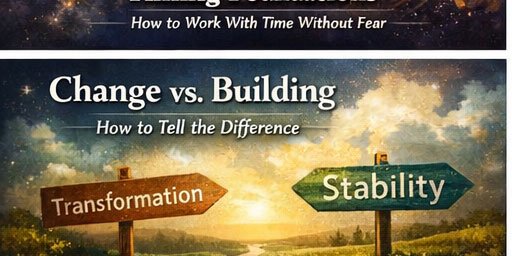
How to Identify Change Seasons vs Building Seasons

How to Identify Change Seasons vs Building Seasons

One of the most important timing skills is knowing whether a client is in a change season or a building season. Getting this wrong is expensive. This article teaches you how to identify the season using three layers (reality, core pattern, and timing), which Personal Years tend toward change vs building, how to interpret confusing combinations like Year 5 inside Pinnacle 4, and two professional action frameworks (a 14-day change plan and a 30-day building plan) with metrics. This is timing that produces better decisions, not fear.

Dual Timeline Method: How to Combine Personal Year, the 9-Year Cycle, and Pinnacles & Challenges

Dual Timeline Method: How to Combine Personal Year, the 9-Year Cycle, and Pinnacles & Challenges

Most people throw multiple cycles at clients and create confusion. Professionals build one clear timeline. This article teaches you how to combine Personal Year, the 9-year cycle, and Pinnacles & Challenges without contradictions: which layer manages the season, which layer defines the project phase, which layer defines execution, how to spot the dominant layer, and how to close with one weekly action and one metric. This turns numerology timing into a real decision tool, not a pile of interpretations.

Personal Year, Personal Month, Personal Day - When to Use Which

Personal Year, Personal Month, Personal Day - When to Use Which

Personal Year, Personal Month, and Personal Day are three different tools. Used correctly, timing becomes a clear process instead of a vague prediction. This article teaches you how to choose the right timing resolution by question type, when each layer is strongest, which mistakes to avoid, and how to connect year-month-day into one actionable plan with a measurable metric. That is what makes professional numerology timing practical, ethical, and genuinely helpful without scaring clients.

Timing Foundations: How to Work With Time Without Scaring People

Timing Foundations: How to Work With Time Without Scaring People

Timing is one of the most powerful tools in numerology, and also one of the most dangerous when it becomes fear or prophecy. This article teaches a professional, ethical way to work with time: what timing is and isn’t, key ethics rules, a 4-layer model for building timing readings without drama, how to neutralize client fear by understanding pattern-based stress needs, and how to end every timing session with one action and one metric that creates real results.

Subscribe for Full Access

Learn and deepen your numerology knowledge with our professional articles

Subscribe for Full Access

Accessibility

Text Size
Display
Reading
Spacing