Online Numerology Course - What You Learn, What You Practice, and How to Get Certified-Level Skill
An online numerology course should do two things at the same time: teach you the system clearly, and train your interpretation skill through practice. If a course only gives meanings, you will know “definitions” but you will not know how to read a real person.
This page explains what a high-quality online numerology course looks like, what a complete curriculum should include, how practice should be structured, and how you can turn an online course into confident, repeatable reading ability.
What you should learn in a complete online numerology course
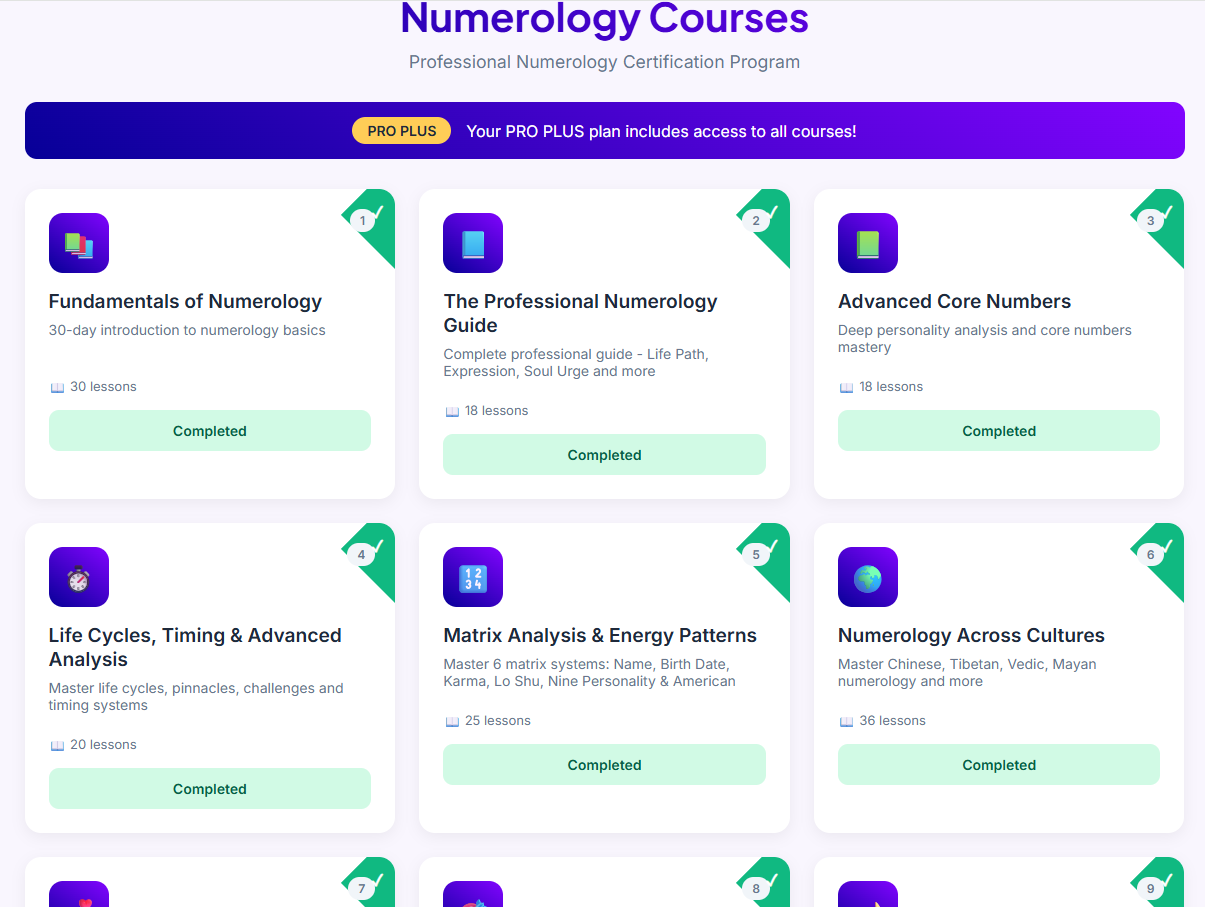
A strong course is built in layers. Here is the full set, from beginner to practitioner:
Layer 1 - Foundations
- numerology system rules and reduction logic
- meanings 1-9 using a professional template
- master numbers as intensity plus responsibility
- compound numbers and why they matter
Layer 2 - Core chart numbers
- Life Path (date based)
- Expression (full name)
- Soul Urge (vowels)
- Personality (consonants)
- Maturity (integration number)
Layer 3 - Combination reading
- inner vs outer (Soul Urge vs Personality)
- direction vs expression (Life Path vs Expression)
- repeating themes and dominant numbers
- tension and balance plans (how to solve contradictions)
Layer 4 - Timing and strategy
- Personal Year, Month, Day (what is active now)
- Pinnacles and Challenges (life phases and friction)
- how to translate timing into decisions and action plans
Layer 5 - Professional practice
- client intake questions and boundaries
- report writing structure
- ethics and responsible language
- session flow: how to deliver a reading
How practice should be designed (so you actually improve)
Practice is the engine of skill. A course should include:
- guided practice charts: step-by-step readings with explanation
- homework charts: you interpret on your own using templates
- checklists: to avoid missing key elements
- feedback: mentor, graded homework, or community reviews
Sample practice method (the “20-chart drill”)
If your course does not provide enough practice, use this drill:
- Generate 20 charts (friends, family, public figures).
- For each chart, write a 7-bullet summary.
- Write one combination insight (inner vs outer).
- Write a 30-day action plan with 3 steps.
- After 10 charts, compare your language and remove vagueness.
By the end, you will sound more professional and more consistent.
What makes an online course “professional”?
| Professional feature | Why it matters |
|---|---|
| Clear templates | Creates repeatable, high-quality readings |
| Tools and calculators | Reduces errors and speeds up practice |
| Case studies | Shows how theory becomes real interpretation |
| Feedback | Fixes blind spots and builds confidence |
| Ethics and boundaries | Makes your work responsible and trustworthy |
How to study an online numerology course without burnout
- Set a weekly schedule: 2-4 hours is enough if you are consistent.
- Practice immediately: every lesson should create an output.
- Use one tool consistently: avoid comparing 10 calculators.
- Keep a “reading journal”: write your summaries and track improvement.
- Focus on clarity: your goal is to explain numbers in simple language.
Should your online course include certification?
Certification is useful if it is meaningful. A serious certification includes:
- clear learning outcomes
- practice requirements (number of readings)
- assessment (quiz, exam, or case review)
- professional ethics standards
If certification is only a PDF with no standards, it is marketing, not education. That does not mean it is “bad”, but it is not a professional credential.
FAQ
What is the best online numerology course for beginners?
The best beginner course is the one that teaches foundations, includes practice charts, and uses clear templates. “Best” is not only content, it is practice structure.
Can I become a practitioner from an online course?
Yes, if you practice regularly and get feedback. Many professional skills can be built online if the program is designed properly.
Do I need advanced math?
No. Numerology uses simple arithmetic and consistent rules. The real skill is interpretation and communication.
Next step
If you want to learn fast, choose an online course that includes tools, practice cases, and templates. Then commit to weekly practice and track your progress across 20-50 charts.
Sample assignments (what “real practice” looks like)
A strong course will not only tell you meanings. It will require output. Examples of good assignments:
- Assignment 1: write 9 mini-guides (1-9) using the same template.
- Assignment 2: create a 1-page chart summary for 5 different people.
- Assignment 3: write 10 “inner vs outer” insights (Soul Urge vs Personality).
- Assignment 4: write a personal year plan with practical steps.
- Assignment 5: produce a short written report with a clear action plan.
Mini report template (use this as your structure)
Here is a simple structure many practitioners use:
- Summary: 5 bullets of the main themes.
- Core numbers: Life Path, Expression, Soul Urge, Personality (each with strengths, shadows, actions).
- Combination insight: one tension and one balance recommendation.
- Timing now: current personal year theme and focus.
- Action plan: 3 steps for 30 days.
How to translate numerology into coaching (so clients feel value)
Clients value clarity and action. When you interpret a number, always answer:
- What is the healthy expression?
- What is the stress expression?
- What habit makes the healthy side stronger?
This approach makes your readings grounded and practical.
More on ethics and boundaries
Professional work requires responsible language. Avoid absolute claims. Use conditional and choice-based language:
- Instead of “you will fail”, say “if you avoid structure, results may be delayed”.
- Instead of “this year is bad”, say “this year asks for completion and releasing what is done”.
Ethical language protects your clients and builds trust.
Extra FAQ
Can I study at my own pace?
Yes. The best programs include a self-paced library plus optional live support. Self-paced learning works if you keep a weekly schedule.
Will I be able to read charts after the course?
If you complete practice requirements and use the templates, yes. The goal is not only knowledge. The goal is repeatable reading skill.
Do I need to memorize every number meaning?
No. Use templates and build a personal reference. With practice, the language becomes natural.
Live sessions vs self-paced - which is better?
Both formats can work:
- Self-paced: best for flexible schedules. Works if you keep a weekly routine.
- Cohort or live: best for motivation and feedback. Works if you can attend sessions.
The strongest programs combine both: a lesson library plus optional live support.
Graduation outcomes (what you should be able to do)
After completing a solid online numerology course, you should be able to:
- calculate core numbers consistently
- generate a full chart and explain each part simply
- write a structured chart summary
- identify one key tension and offer a balance plan
- use timing to define a “next step” strategy
- deliver a reading ethically and confidently
Client workflow preview (for students who want professional practice)
- Intake: clarify the question and the goal.
- Chart review: highlight the Big 4 and dominant themes.
- Combination insight: identify tension and alignment.
- Timing: current year focus and best actions.
- Action plan: 3 steps, measurable, realistic.
This workflow is simple, but it feels professional because it is structured and practical.
How to practice with friends (without feeling awkward)
If you need practice charts, start simple. Ask friends for permission, keep the reading short, and focus on strengths plus one practical suggestion. Avoid heavy claims. A 15-minute practice reading is enough to build skill and confidence.
After the session, ask one feedback question: “What part felt accurate and useful?” Then refine your language. This feedback loop is the fastest way to improve.
Calculate your numerology chart
The PNA calculator computes all core numbers for free. PRO extends it to 750+ values across 31 modules.
Free calculator → PRO calculator · 750+