
Professional Numerology Association
Login to Your Account Back to Home

Numerology Articles

Learn and deepen your numerology knowledge with our professional articles

All Categories Introduction to Numerology Personal Numbers Relationships Career & Finances Numerology & Dates Spiritual Growth Advanced Techniques Case Studies FAQ
Full Reading Example: Money Pressure and Self-Worth (Fear, Control, Avoidance)

Full Reading Example: Money Pressure and Self-Worth (Fear, Control, Avoidance)

Money anxiety is often not an income problem but a numerology-driven emotional pattern: 8 and 1 tying results to identity, 4 chasing safety through control, Heart 2 combined with 9 creating shame around asking, and 7 producing overanalysis and delay. This PNA case study presents a full reading for a client with Life Path 8, Expression 4, Heart 2, Personality 7, dominant 1 and 9, missing 6 and 5, in a Personal Year 8 and Personal Month 4. You’ll learn how to separate math from self-worth, identify the exact driver (fear, shame, control, or avoidance), and apply a 30-day plan that turns money from a spiral into a system: the three numbers of 4, clean 8 terms, ethical 2-9 pricing language, 7 decision containers, weekly 5 experiments, and a 6 stability ritual. The result is measurable: lower anxiety, clearer choices, and money confidence built through structure and action.


Full Reading Example: Family Boundaries and Emotional Guilt

Full Reading Example: Family Boundaries and Emotional Guilt

Family boundaries are rarely just about saying no - they are about holding love without sacrificing the self. This PNA case study presents a full reading for a client with Life Path 6, Expression 2, Heart 9, Personality 4, dominant 11/2 and 7, missing 1 and 8, in a Personal Year 6. You will learn how guilt and people-pleasing collapse boundaries, how 4 and 6 family roles become identity, and why missing 1 and 8 lead to apologizing, over-explaining, and pressure leverage. The article delivers a 21-day boundary system in three layers: clear 8 terms (time, money, involvement), clean 1 “no” statements without stories, and 2+9 empathy that keeps connection without surrender. This turns resentment into structure, stability, and respectful relationship.

Full Reading Example: High Standards and Burnout

Full Reading Example: High Standards and Burnout

High standards can produce excellence, but when they become a whip they create burnout. This PNA case study presents a full reading for a client with Life Path 4, Expression 8, Heart 6, Personality 7, dominant 1, weak 3, missing 2 and 5, in a Personal Year 8. You will learn how 4 and 7 fear chaos and error, how 8 ties outcomes to worth, and how Heart 6 carries guilt that blocks rest. The article delivers a 30-day “healthy standard” system: minimum truth rules that allow finishing, success metrics that include stability, service capacity limits, identity separation practices, support structures (2), oxygen routines (5), and deliberate 3-release so the nervous system can discharge pressure. This keeps quality high and restores life, without sacrificing professionalism.

Full Reading Example: Career Change Under Pressure

Full Reading Example: Career Change Under Pressure

A career change under pressure is not just job hunting - it is building stability while the ground shifts. This full PNA case study shows a client with Life Path 8, Expression 4, Heart 9, dominant 7, Personality 3, missing 2 and 5, in a Personal Year 9. You will learn how to separate real calling from escape, why 8 and 4 freeze without numbers and rails, why Heart 9 collapses without meaning, and why 7 needs controlled experiments instead of dramatic leaps. The article gives a 60-day transition plan built on three containers (identity, time, money), a weekly schedule, small tests, boundaries and terms, and a three-track income model that keeps 8 grounded. This turns “I need a change” into a measurable transition that protects stability while creating real movement.

Full Reading Example: Confidence and Visibility - Fear of Being Seen

Full Reading Example: Confidence and Visibility - Fear of Being Seen

Visibility fear is not a lack of talent. It is a predictable numerology structure where Life Path 1 turns exposure into an identity exam, Expression 3 turns it into a judgment exam, Heart 7 demands perfection, and 11/2 amplifies nervous-system sensitivity. This full PNA case study shows a complete reading and a 28-day measurable exposure container: graded exposure levels, a “minimum truth” rule that calms 7, regulation boundaries that protect 11/2, tiny 4 consistency that builds stability, and clean 8 offers with clear terms. This turns “I’m afraid to be seen” into a practical system that builds real confidence through repetition, boundaries, and measurable progress.

Full Reading Example: Relationship Distance Pattern

Full Reading Example: Relationship Distance Pattern

Relationship distance is not always a love problem - it is often a safety strategy coded in the numbers. This full PNA case study shows a classic chase-withdraw pattern: one partner withdraws for safety (7-4-Heart 5-1) while the other pursues connection for safety (2-6-Heart 9-3). You will learn how to identify the distance type, translate withdrawal without blame, and build a 30-day “closeness with space” container: a return-time agreement for 7 and 5, a weekly 4 conversation template, clean 8 boundaries that protect both partners, and a simple daily practice that restores warmth. This turns repeating conflict into a stable relationship language.

Full Reading Example: Scattered Focus, Procrastination, and Low Consistency

Full Reading Example: Scattered Focus, Procrastination, and Low Consistency

Scatter and procrastination are rarely a character flaw. They are a predictable numerology structure that appears when strong 5 and 3 creativity and movement are not supported by 4 consistency, especially with Heart 1 identity pressure and 7 perfection loops. This full PNA case study shows how to diagnose the procrastination type, build a tiny “4 skeleton” with 20 minutes a day, apply the “finish before you edit” rule that protects 3, create freedom inside rails for 5, and strengthen missing 8 through one external commitment lever. You will get a 21-day plan with clear metrics that builds real consistency without fighting your nature.

Full Reading Example: High Sensitivity and Emotional Overload

Full Reading Example: High Sensitivity and Emotional Overload

High sensitivity is a gift, but without structure it becomes emotional overload. This full PNA case study shows how to read overwhelm through the numbers: Life Path 11/2 as an open antenna, Heart 6 as responsibility and guilt, Expression 3 as sensitivity to tone and judgment, dominant 7 as deep processing that becomes rumination, and missing 4 and 8 as weak structure and capacity boundaries. You will learn how to separate intuition from anxiety, build “small 4” stabilizing habits, train clean 8 terms, and use a 14-day container with measurable metrics that restores grounding without shutting the gift down.

Full Reading Example: A Client Who Feels Stuck

Full Reading Example: A Client Who Feels Stuck

Stuckness is not laziness. It is a protective structure that shows up clearly in the numbers. This full PNA case study demonstrates how to read “I’m stuck” through a common pattern: Life Path 7 overthinking, Expression 4 perfection structure, Heart 2 rejection sensitivity, 9 meaning pressure, and missing 8 weak pricing and authority. You will learn a 3-minute diagnosis, an anchor sentence that unlocks movement, and a one-week action container that builds real progress: one offer, minimal structure, one written boundary, and one measurable metric. This turns “I can’t move” into grounded action that respects truth, integrity, and professional ethics.

How to Build a Process That Makes Clients Feel Safe - A Numerology Container That Creates Trust, Depth, and Results

How to Build a Process That Makes Clients Feel Safe - A Numerology Container That Creates Trust, Depth, and Results

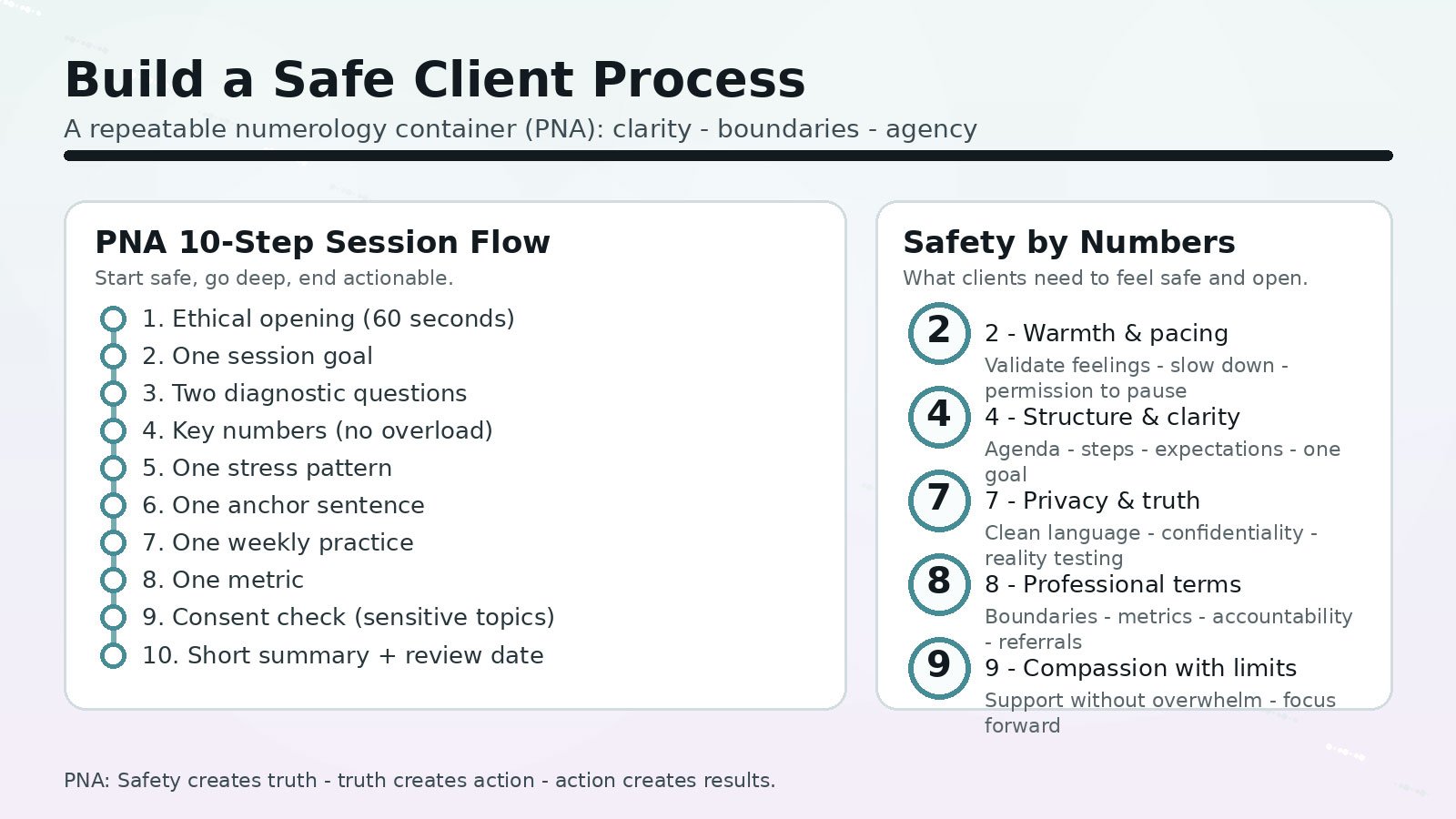
Safety is the foundation of a high-quality numerology reading. This article teaches the PNA method for building a repeatable safety container: clarity, boundaries, and agency. You’ll learn a 60-second session opening script, how to match language to different numerology safety styles (numbers 1-9), how Heart numbers reveal what clients need to relax and trust, how missing numbers create safety leaks and how to correct them with simple skills, how stress mode changes behavior, and how timing cycles (personal year and month) affect capacity. The article provides a practical 10-step session protocol that always ends with one anchor sentence, one weekly practice, and one measurable metric. The result is a grounded spiritual process that creates real progress without overwhelm and without dependency.

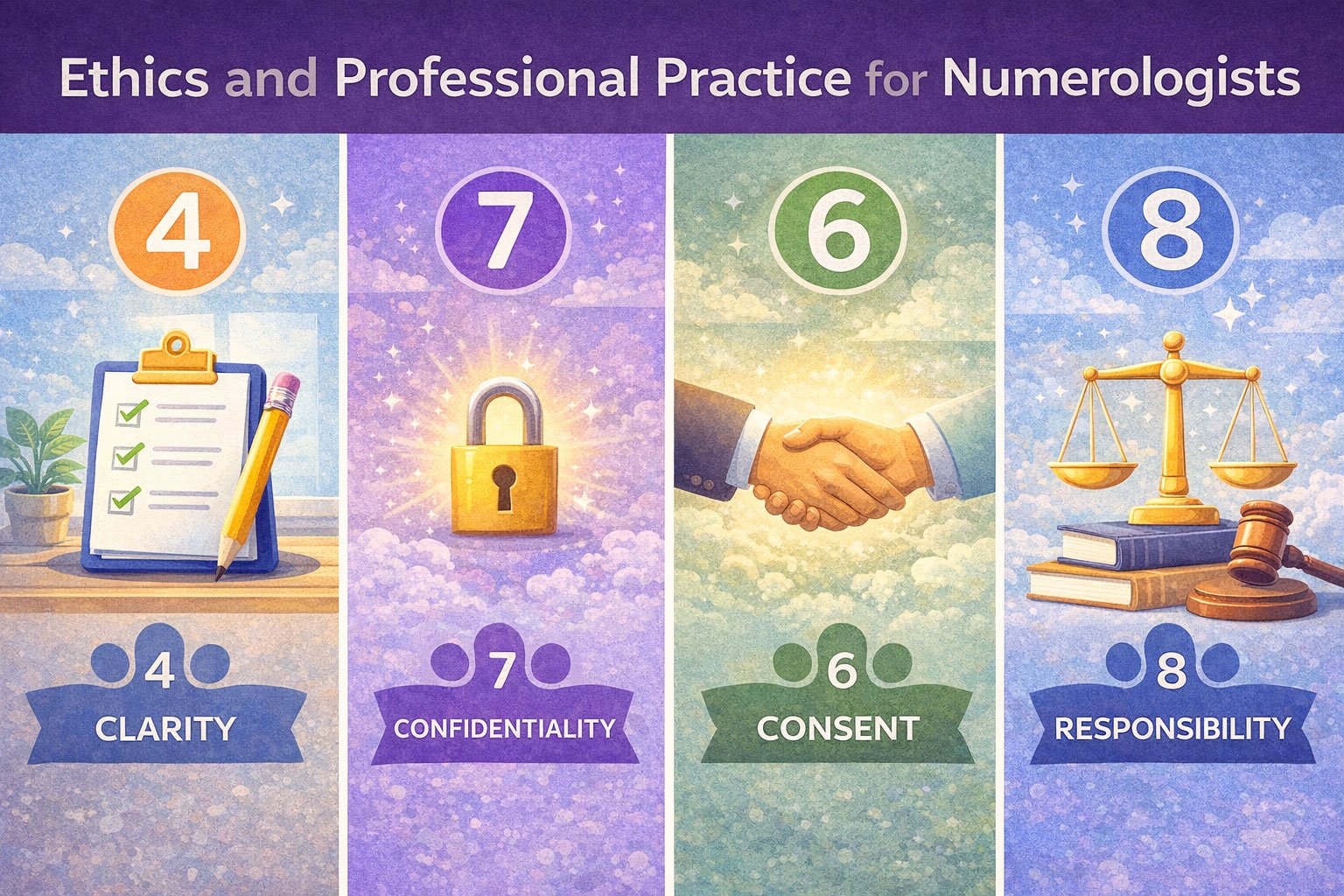
How to Write Professional Responsibility on Your Website and in Sessions - The PNA Numerology Standard (Clear, Human, Not Legalistic)

How to Write Professional Responsibility on Your Website and in Sessions - The PNA Numerology Standard (Clear, Human, Not Legalistic)

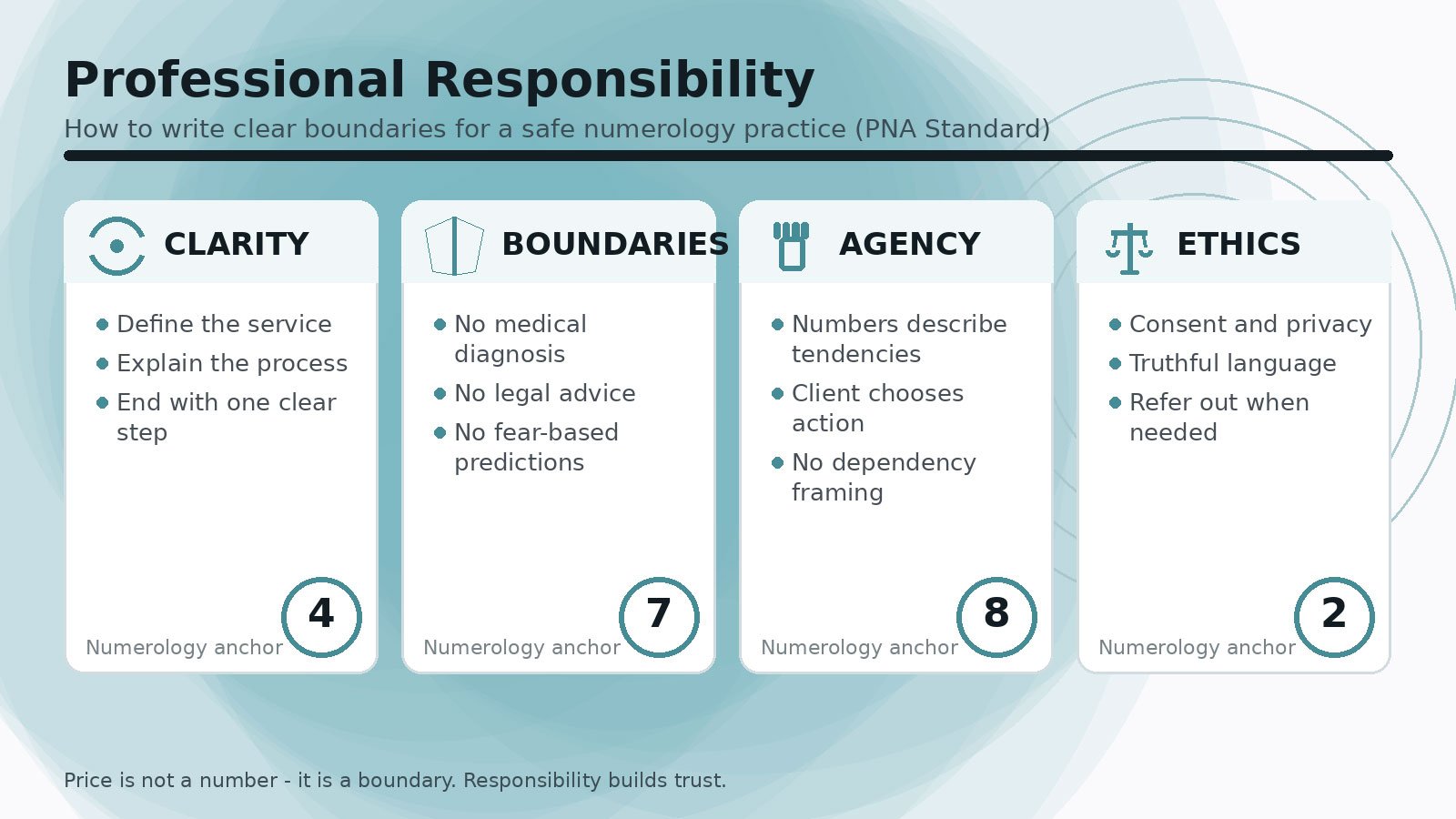
A clear responsibility statement is what makes a numerology website feel safe, ethical, and credible. This article teaches the PNA standard: how to define what your readings do provide (pattern clarity, stress mode mapping, timing strategy, practices, and metrics) and what they do not provide (medical diagnosis, legal advice, and unavoidable predictions) without sounding cold or legalistic. You’ll learn how different number patterns experience disclaimers and responsibility language, and how to adapt your phrasing for dominant numbers, Heart needs, missing numbers, stress mode, master numbers 11/22/33, and timing cycles like personal years 2, 7, 8, and 9. The article includes three website-ready versions (ultra-short, short, and full policy page), a 30-second session opening script, number-based responses to “tell me what will happen,” a client-friendly FAQ section, and a practical case example. The result is a trust-building framework that reduces anxiety, prevents dependency, increases professionalism, and makes your numerology practice feel modern and grounded.

Consent, Privacy, and Session Documentation - A Numerology Protocol That Protects the Client and You

Consent, Privacy, and Session Documentation - A Numerology Protocol That Protects the Client and You

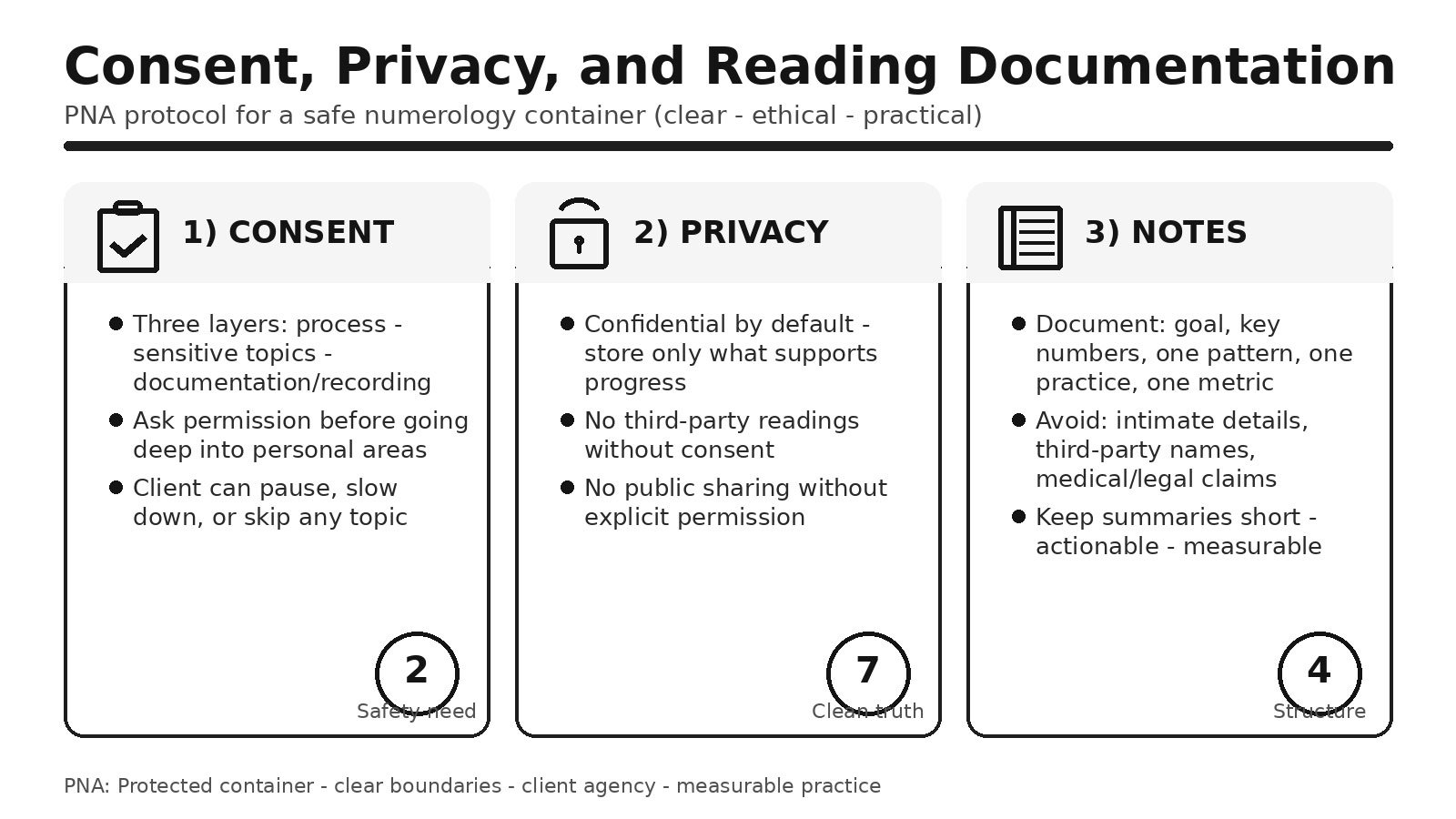
Consent, privacy, and documentation are what turn numerology into a safe, modern, professional container. This article teaches the PNA protocol: three layers of consent (process consent, sensitive-topic consent, and documentation/recording consent), practical privacy standards for website and sessions, and a clean documentation system that separates facts from interpretations. You’ll learn to adapt consent language, pacing, and note-taking style to different numerology patterns using dominant numbers, Heart numbers, missing numbers, stress mode, master numbers (11/22/33), and timing cycles (personal year/month/day). The article includes ready-to-use scripts, a repeatable documentation template, ethical handling for third-party requests, and number-based micro-metrics that make growth measurable. The result is a high-trust practice that reduces overwhelm, prevents dependency, protects privacy, and helps clients grow through clear, grounded numerology.

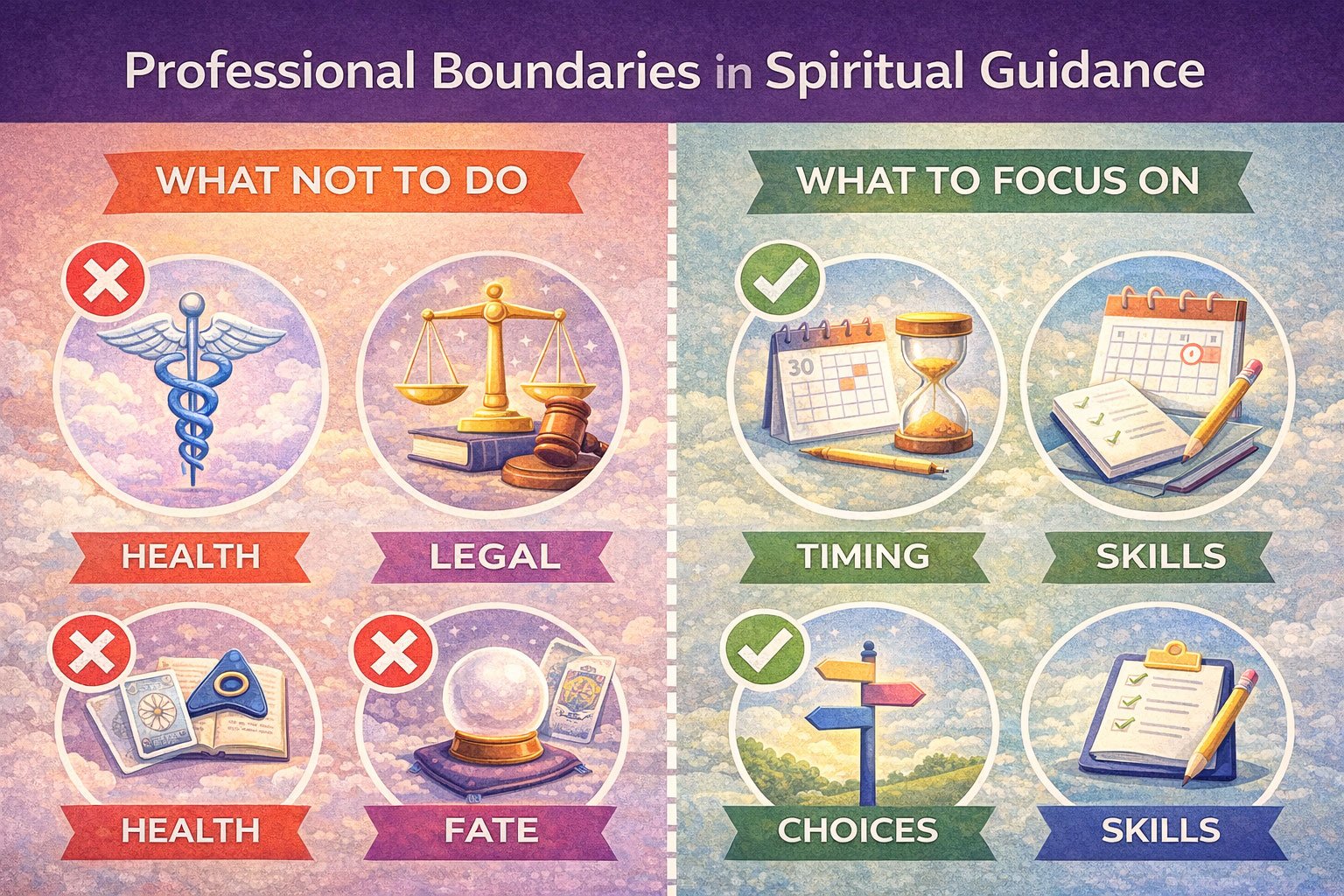
Handling Questions About Health, Legal Issues, or “Fate” - A Numerology-Based Professional Response Protocol

Handling Questions About Health, Legal Issues, or “Fate” - A Numerology-Based Professional Response Protocol

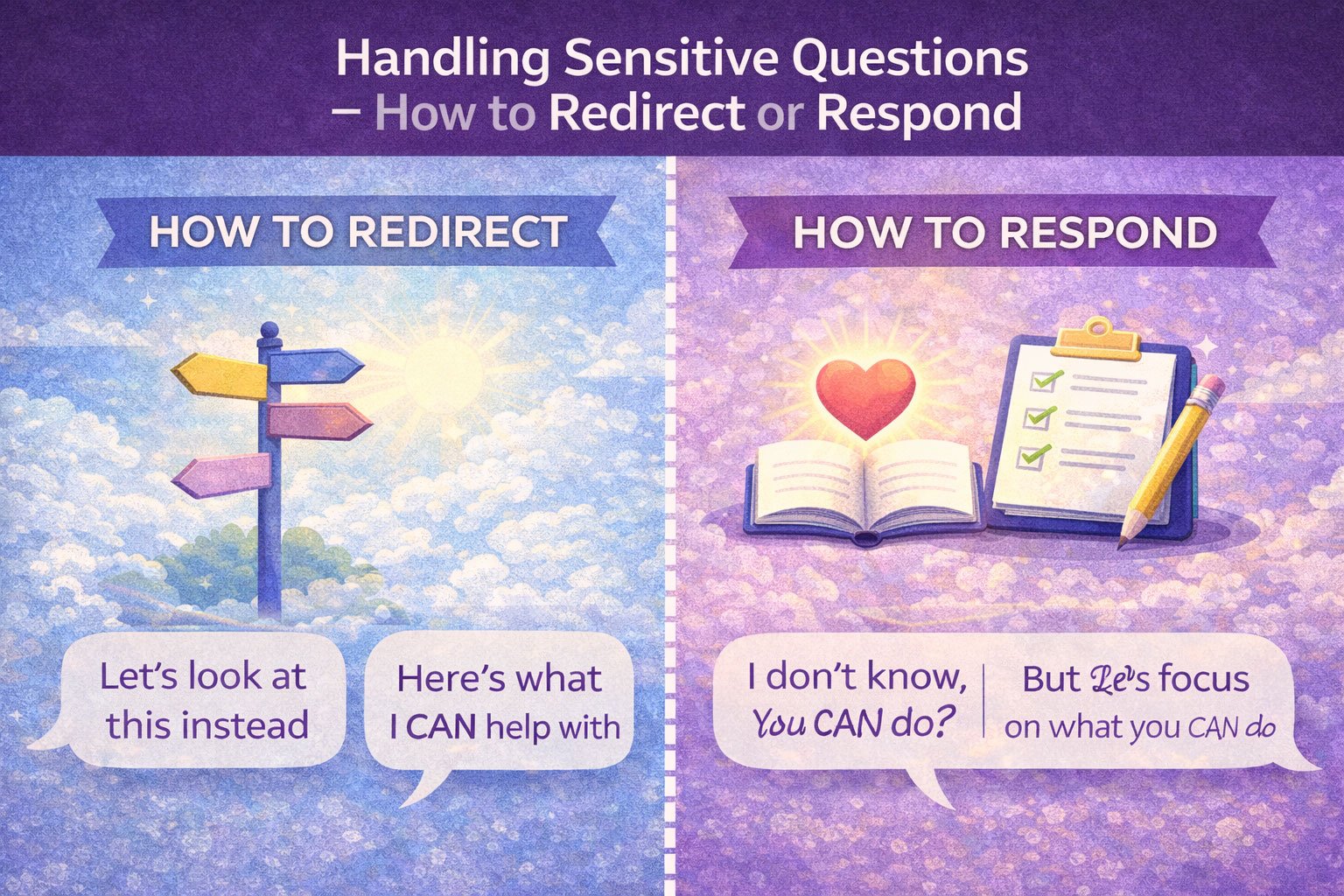
Clients will ask about health, legal outcomes, and “fate.” This article teaches the PNA response protocol: how to set ethical boundaries without sounding cold, how to transform an unsafe question (“What will happen?”) into a professional one (“How do I act wisely?”), and how to use deep numerology to deliver real value without predicting or diagnosing. You’ll learn to identify which number is asking (dominant numbers and Heart needs), how missing numbers create anxiety and boundary leaks, how stress-mode patterns distort perception, how timing cycles (personal year/month/day) change capacity, and how to work with master numbers 11/22/33 without overload. The article includes ready-to-use scripts, number-based response strategies, and a full case study showing how to reduce fear, prevent dependency, and turn heavy questions into measurable action steps.

Professional Boundaries: What You Say and What You Don’t Say - The PNA Numerology Standard

Professional Boundaries: What You Say and What You Don’t Say - The PNA Numerology Standard

Professional boundaries are what turn numerology into a safe, ethical, high-trust practice. This article teaches the PNA standard: what you never say (fear-based predictions, health/legal claims, destiny verdicts, dependency language), what you say instead using the Pattern-Impact-Choice model, and how to describe shadow patterns as stress mode rather than identity. You’ll learn how to adapt boundary language to dominant numbers and Heart numbers, how missing numbers create automatic boundary leaks, how timing cycles (personal year/month/day) change a client’s sensitivity, and how to work with master numbers 11/22/33 without overload or pressure. The article includes 12 ready-to-use boundary sentences, a fate-question script, and a full case example showing how boundaries reduce anxiety and prevent dependency. The result is a client-centered numerology process that protects people, builds trust, and creates real progress.

How to Build a Process That Makes the Client Feel Safe - A Numerology Protocol for Trust, Boundaries, and Momentum

How to Build a Process That Makes the Client Feel Safe - A Numerology Protocol for Trust, Boundaries, and Momentum

Clients don’t continue a numerology process because the interpretation felt “accurate.” They continue because the process feels safe. This article teaches the PNA numerology protocol for designing safety using the full map: dominant numbers (Life Path/Expression) to understand operating style, Heart numbers to identify emotional safety needs, missing numbers to locate weak regulation links, stress mode to avoid shame-based language, master numbers (11/22/33) to adjust sensitivity and pressure, and timing cycles (personal year, month, day) to match the client’s real capacity. You’ll learn how to communicate numbers as pattern plus correction instead of labels, how to run a repeatable six-part session structure that creates predictability, how to tailor pacing and communication to each dominant number 1-9, and how to track progress with simple weekly metrics. The result is a clear, ethical, client-centered container that builds trust, prevents overwhelm, and turns numerology into a stable growth process clients want to stay in.

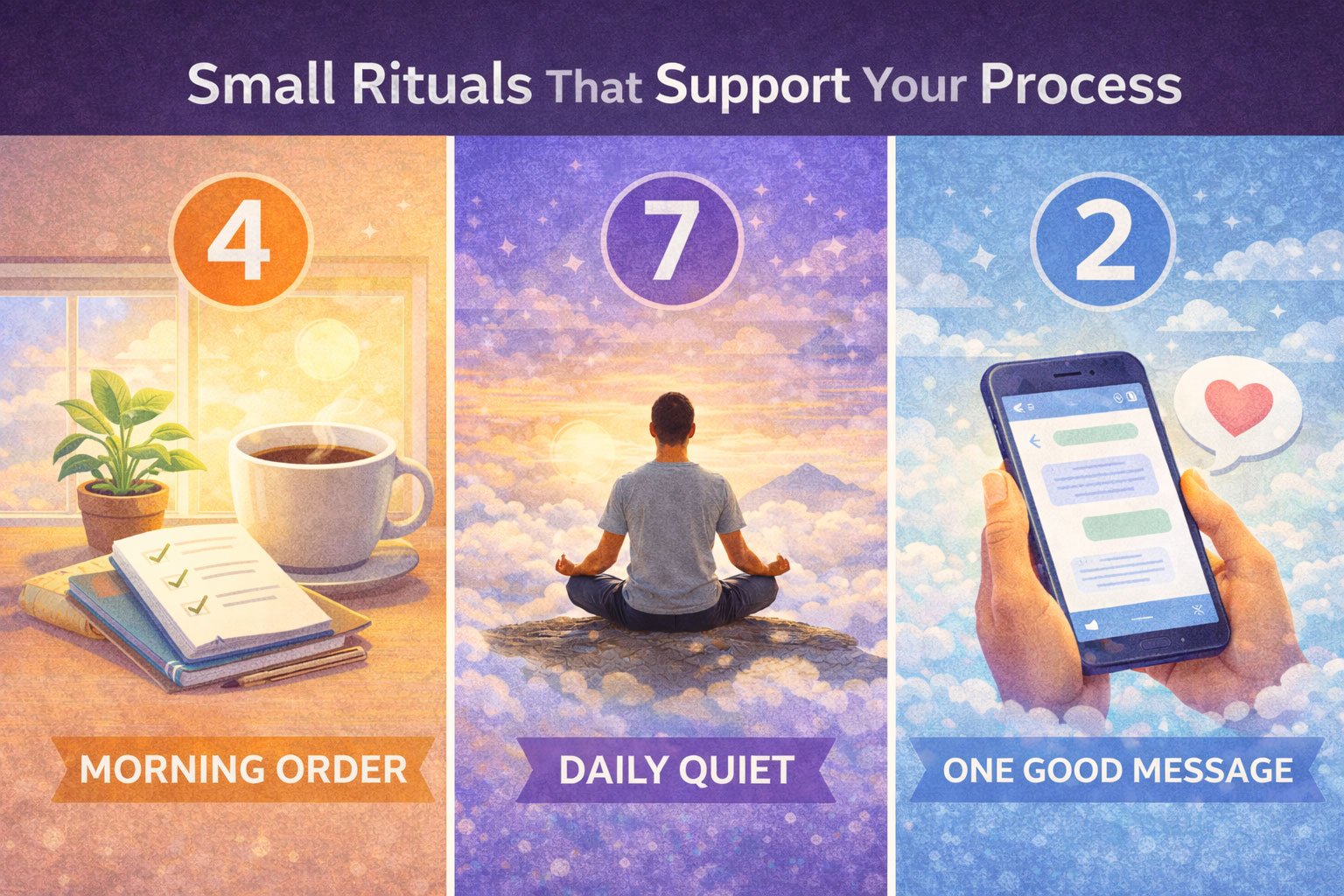
Small Rituals That Support the Process (Not “Magic”) - Numerology Rituals for Grounding and Momentum

Small Rituals That Support the Process (Not “Magic”) - Numerology Rituals for Grounding and Momentum

Small rituals can be a powerful growth tool when used correctly. This article teaches the PNA standard that separates ritual from “magic”: a ritual doesn’t bypass life, it aligns you for action. You get daily rituals for numbers 1-9, missing-number rituals that train the weak link in micro reps, timing-based rituals (personal day, month, year), and master number rituals for 11, 22, and 33 without drama. You also learn how to measure whether a ritual works by behavior change and recovery time, not by a temporary mood. This turns spirituality into a precise numerology-based practice that supports real progress.
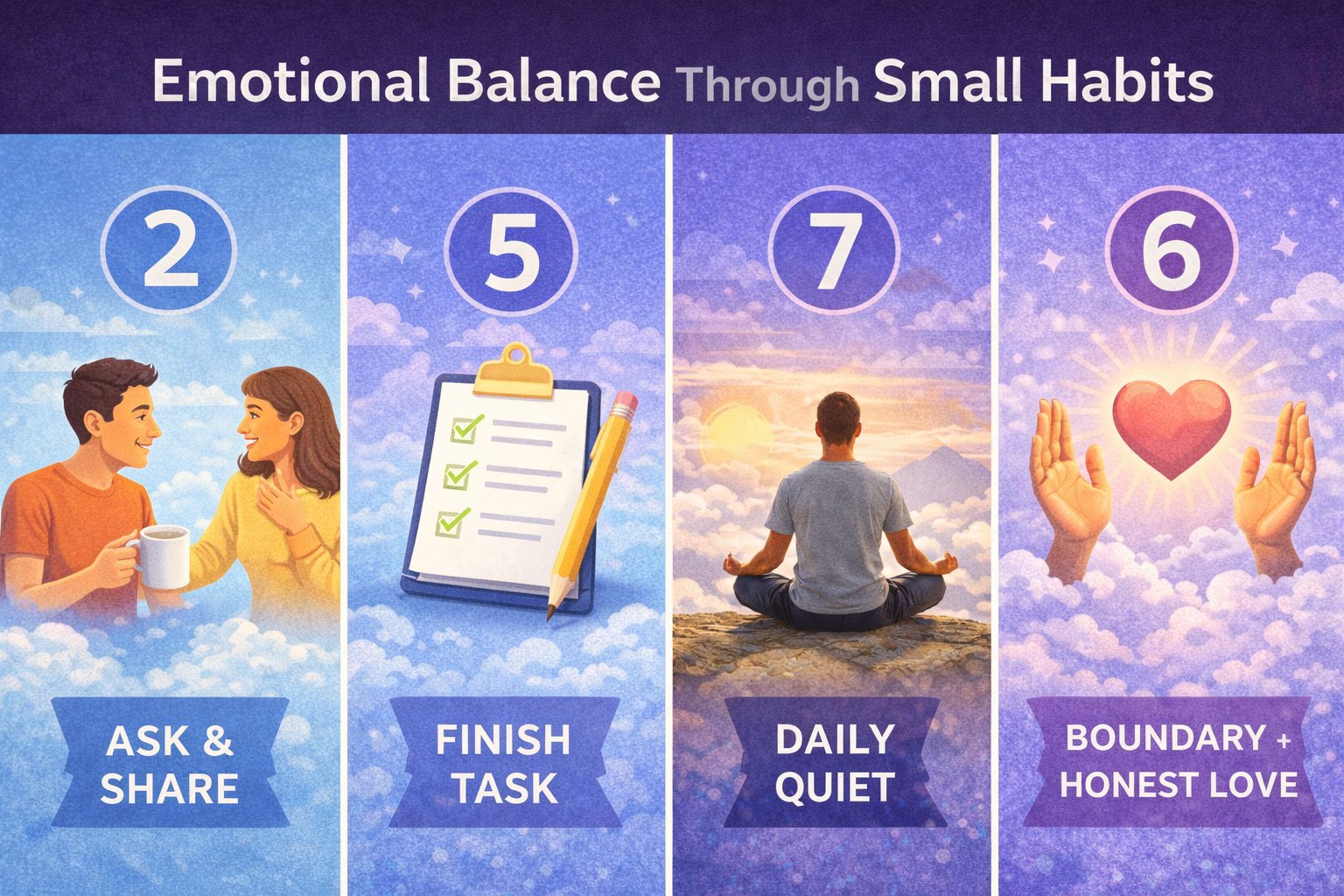
Emotional Balance Through Tiny Habits - A Practical Numerology Protocol

Emotional Balance Through Tiny Habits - A Practical Numerology Protocol

Emotional balance is not a personality trait and not a “spiritual level.” It’s a system built through small consistent habits. Numerology makes it precise: it reveals your stress pattern (dominant number), your emotional safety need (Heart number), and your weak regulation link (missing number). This article teaches the PNA protocol: “number in normal mode vs number under stress,” the three chart points that explain overwhelm, the three-anchor daily system (body, order, meaning) chosen by your numbers, number-based anchor sentences for real-time triggers, and missing-number training as a practical skill. You also get a full case study and a client-ready template. This turns spirituality into stable behavior that protects your relationships, health, and choices.

Meaning, Values, and Mission: Client Exercises That Make It Real

Meaning, Values, and Mission: Client Exercises That Make It Real

Mission is not one perfect answer, and it does not have to be a career. In the PNA standard, mission is consistent expression of values through small actions repeated over time. This article gives you a structured meaning-building method: how to separate excitement from mission, real values from “should” values, seven practical exercises (alive moments, jealousy as compass, intolerance as value, value reduction, repetition timeline, meaning-week experiment), a clean mission-sentence formula, and a 30-day process with measurable metrics. This helps clients move from vague searching to a practical direction that creates energy and results.

Intuition vs Imagination: How to Stay Grounded

Intuition vs Imagination: How to Stay Grounded

Intuition is powerful, but without grounding it is easily confused with imagination, anxiety, hope, or control needs. This article teaches the PNA standard for clean discernment: eight practical differences between intuition and imagination, five diagnostic questions that return you to facts, body signals, and stability, common mistakes like mind-reading or turning signs into commands, and the core tool of running a small experiment before making a big decision. You also get the “three layers” method (fact-story-need) and a full case study showing how to turn a feeling into responsible action. This keeps intuition as a gift and imagination as creativity, without turning spirituality into confusion.
How to Talk About Spirituality Without Being Vague

How to Talk About Spirituality Without Being Vague

Spirituality does not need to be vague. This article teaches how to talk about spirituality in a clean, professional language that connects directly to real life: emotions, values, boundaries, and decisions. You get the PNA model that identifies three forms of vague spirituality (inspiration without responsibility, spiritual talk as shelter from fear, spirituality as identity), practical replacements for common clichés, five grounding anchors that bring any conversation back to reality, a set of deep questions that create truth without drama, and a working template that turns insight into weekly practice and measurable metrics. This turns spirituality into real growth, not pretty words.

Karma vs Pattern: How to Tell a “Lesson” Apart From a Psychological Habit

Karma vs Pattern: How to Tell a “Lesson” Apart From a Psychological Habit

Not everything that repeats is “karma,” and not every struggle deserves drama. This article teaches the PNA standard for separating a karmic lesson from a psychological habit or stress response: four diagnostic questions (time, context, trigger, cost), signs that suggest an active lesson vs signs of stress habit, and why numbers are a direction for investigation rather than proof. You also get a 14-day experiment protocol that replaces arguments with measurable outcomes, plus examples showing how to work responsibly without fear, blame, or fatalism.

How to Explain Karmic Debt Numbers 13, 14, 16, 19 Without Fear or Over-Mystification

How to Explain Karmic Debt Numbers 13, 14, 16, 19 Without Fear or Over-Mystification

Karmic debt numbers 13/4, 14/5, 16/7, and 19/1 do not mean punishment or bad luck. In the PNA standard they point to a repeating behavioral loop that returns until it is learned: the same trigger, the same automatic response, the same cost. This article teaches how to present the topic without fear and without mystical exaggeration, how to diagnose whether the pattern is truly active through real-world repetition, and how to work each number through practical correction protocols with weekly metrics. This turns “karma” from a scary label into a measurable method for change.

How to Craft One Key Sentence That Summarizes the Personal Chart in a Clear, Memorable Way

How to Craft One Key Sentence That Summarizes the Personal Chart in a Clear, Memorable Way

A key sentence is the tool that connects a numerology chart to real change. Instead of sending the client out with many meanings and little direction, you give one sentence they remember, that brings them back on track, and that can be measured. This article teaches the PNA key-sentence formula (gift + boundary + action), how to choose the core pattern from a full chart, seven ready templates for common chart types, and three tests that ensure the sentence is not generic or cliché. You also get a template that turns the sentence into a weekly metric, plus a full case study showing how the right sentence creates fast behavioral shift.

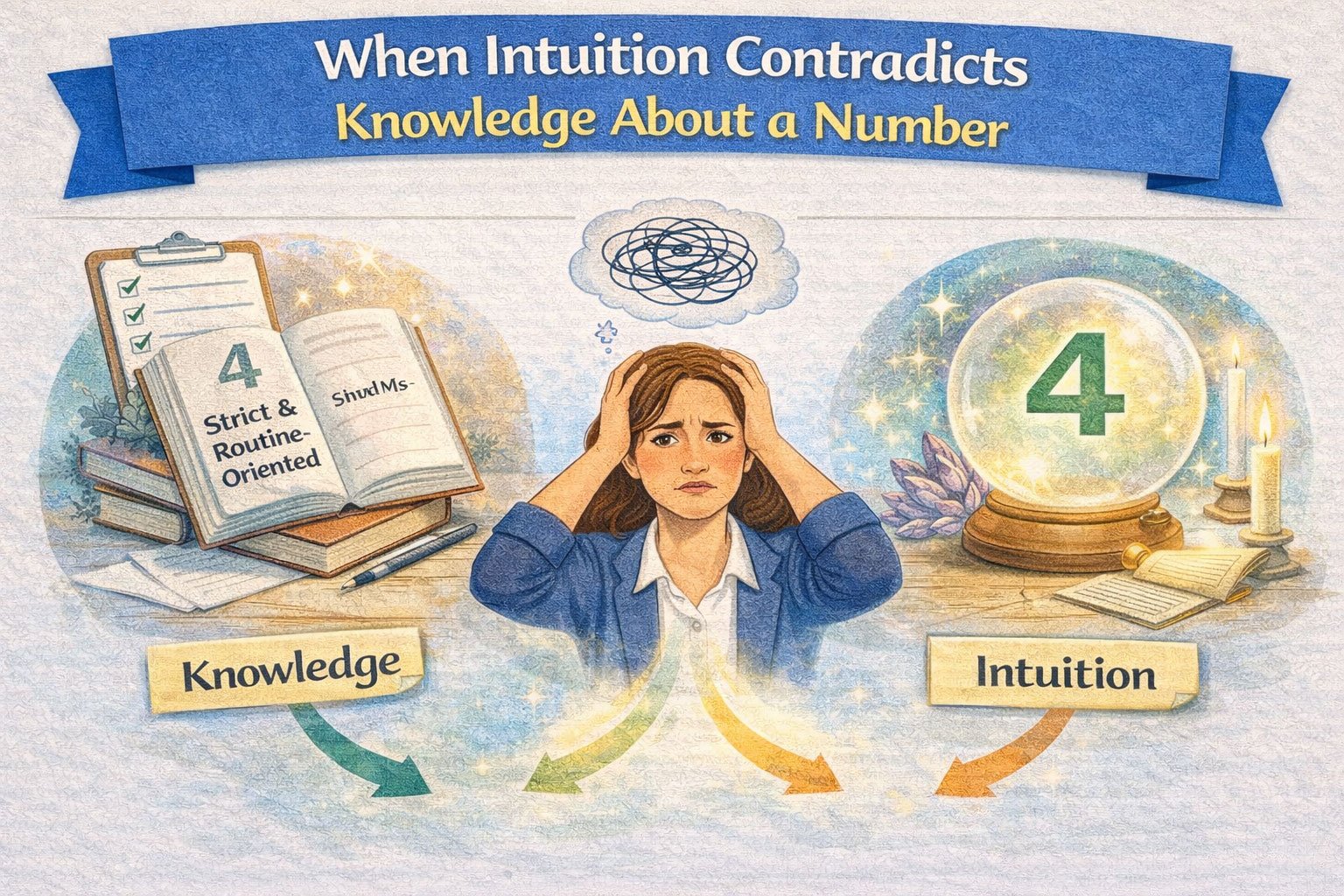
Short Diagnostic Questions for Each Number: Making Sure the Reading Matches Reality

Short Diagnostic Questions for Each Number: Making Sure the Reading Matches Reality

Short diagnostic questions are what turns a numerology reading from a monologue into a professional session. This article gives you ready question sets for numbers 1-9, three rules for asking without leading the client, and what to listen for to distinguish gift vs cost, triggers, and repeating patterns. You also get a diagnostic framework for master numbers and karmic debt numbers that keeps the work grounded and non-dramatic. Finally, you get a translation template that turns answers into a weekly plan with an action sentence and a measurable metric, so the reading actually matches reality and changes behavior.

How to Read Tension Between Numbers: Forward Pull vs Brakes Without Blaming the Client

How to Read Tension Between Numbers: Forward Pull vs Brakes Without Blaming the Client

Many clients feel “I want to move forward, but something in me stops me,” and interpret it as lack of discipline or a character flaw. This article teaches the PNA standard for reading tension: identify a pull mechanism and a brake mechanism, understand the triggers that activate each one, and build a protocol that calms the brake while creating small, stable movement. You get seven common tension patterns (1-2, 5-4, 3-7, 8-2, 6-5, 7-1, 9-8), measurable practices for each, and a weekly worksheet that turns “stuck” into action without shame.

Repeating Numbers in the Birth Date or the Name: What It Means and How Not to Drown in Too Much Information

Repeating Numbers in the Birth Date or the Name: What It Means and How Not to Drown in Too Much Information

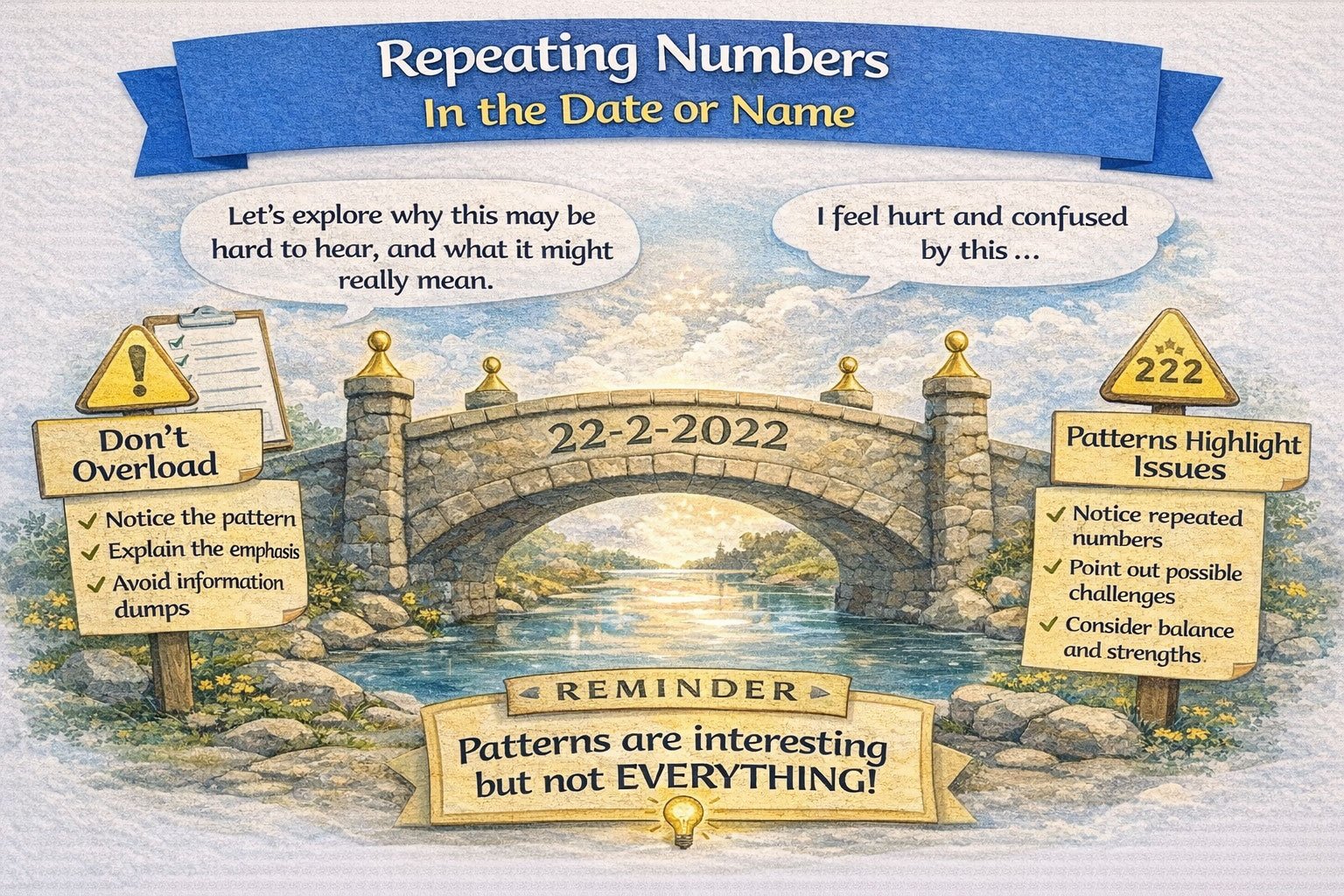
Repeating numbers in the birth date or the name are an amplifier: not destiny and not prophecy, but a clear signal of which mechanisms are more available and how they activate under specific triggers. This article teaches how to separate meaningful repetition from statistical noise, understand four repetition types (birth date, name, core positions, synchronicity), interpret repetition through three practical parameters (what it amplifies, when it activates, what to do this week), and avoid the common mistakes that overwhelm or scare clients. You also get a six-line clinical tool and a full case study showing how “lots of 4” becomes a stability protocol that actually works.

How to Explain Master Numbers 11, 22, 33 Without Drama or Over-Spiritualized Claims

How to Explain Master Numbers 11, 22, 33 Without Drama or Over-Spiritualized Claims

Master numbers 11, 22, and 33 are one of the most confusing areas in numerology because it is easy to turn them into drama or mystical claims. This article teaches the PNA standard: a master number is high potential with high demand, and it always rests on a base (11 on 2, 22 on 4, 33 on 6). You learn how to test whether a master is active in real life or only “written,” how to recognize the real risks (nervous overload, perfectionism, burnout), and how to build measurable weekly practices that turn master pressure into stable impact. You also get clinic-ready lines and a full case study that shows how a master becomes a tool, not a burden.

When One Number “Cancels” Another and When It Only Softens It: Layers, Not Contradictions

When One Number “Cancels” Another and When It Only Softens It: Layers, Not Contradictions

Clients feel contradiction when they hear labels instead of mechanisms. This article teaches layers, not conflicts: what people call “cancellation” is usually delay, softening, channeling, or cover through overcompensation. You get a PNA five-question model that dissolves confusion, six common contradiction patterns (1-2, 4-5, 6-5, 7-3, 8-2, 9-8) with balancing sentences, and a weekly layer-protocol template that turns conflict into measurable action. It transforms “I’m the opposite of myself” into a structured strategy that creates stability.
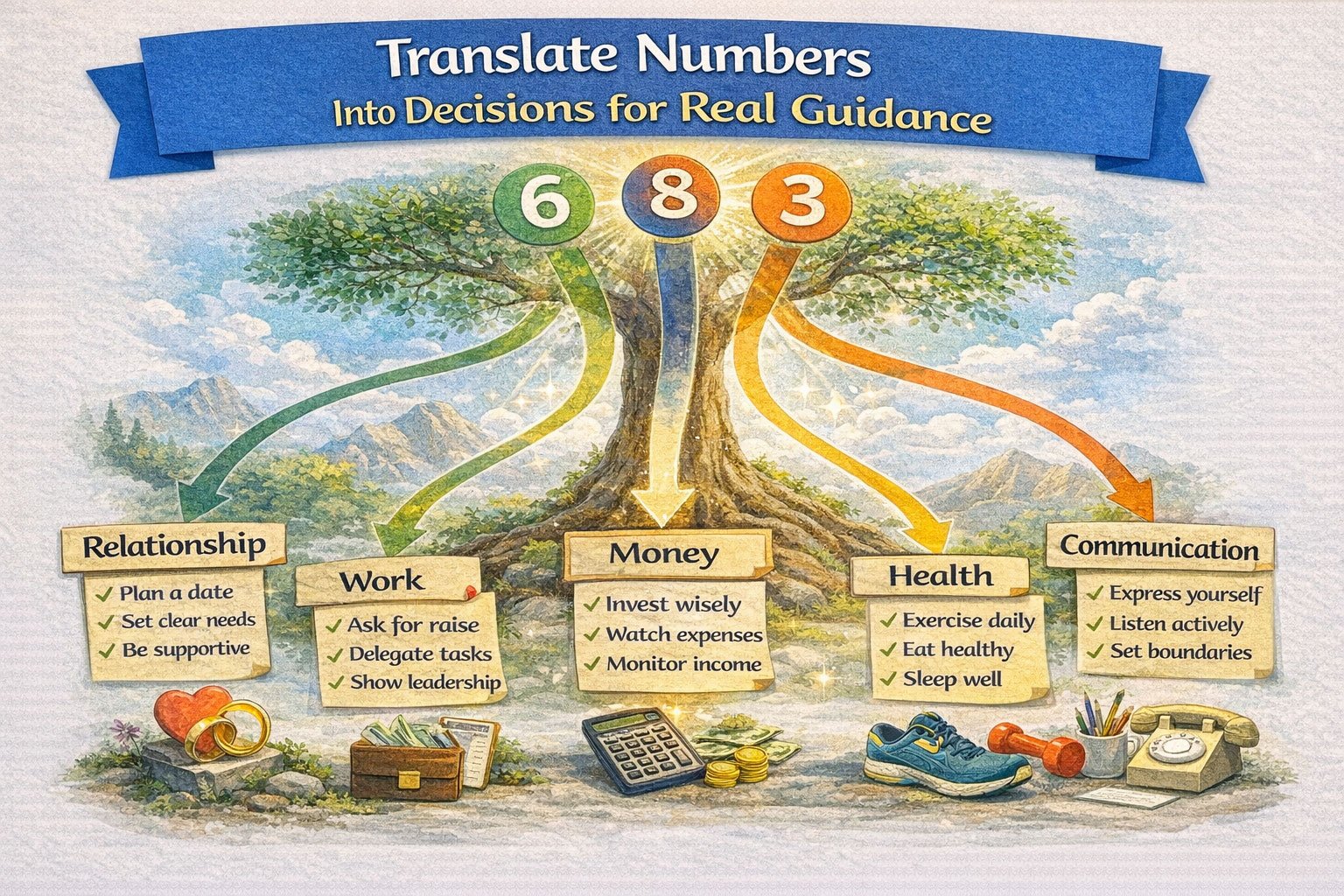
How to Translate Numbers Into Decision Language: Relationships, Work, Money, Health, Communication

How to Translate Numbers Into Decision Language: Relationships, Work, Money, Health, Communication

Numbers should not only describe who you are. They should upgrade what you do. This article teaches a PNA translation method that turns every number into a trigger, an automatic tendency, and a measurable weekly decision. You get a full decision map for numbers 1-9 across five arenas: relationships, work, money, health, and communication, plus a simple prioritization rule that prevents overload and a client-ready Weekly Decision Map that feels like a real protocol. It turns numerology from insight into action.
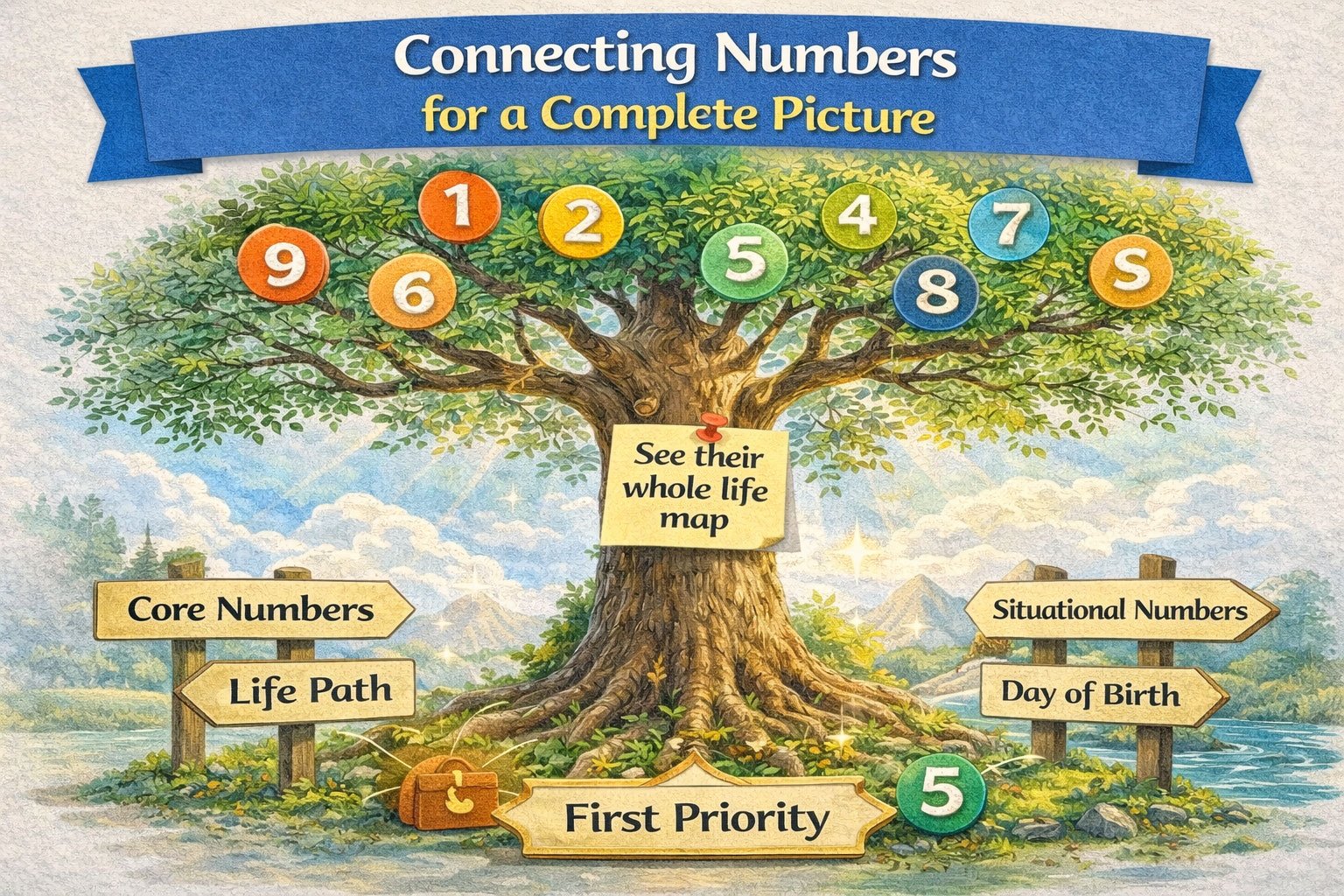
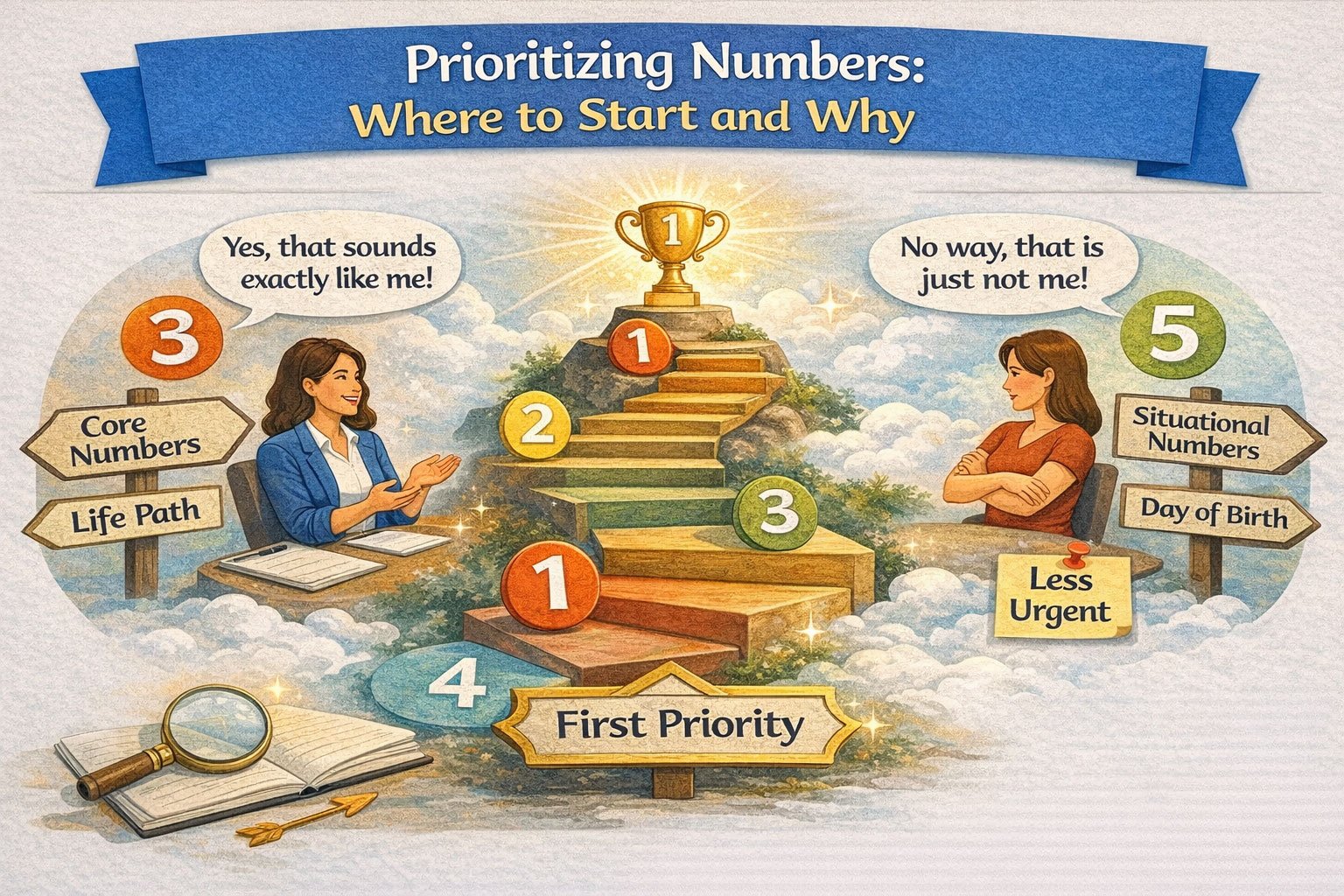
Reading Priorities: Which Number to Start With and Why

Reading Priorities: Which Number to Start With and Why

The biggest problem in overloaded readings is not accuracy, it is order. This article teaches a PNA priority model: three layers (core engine, decision style, fine tuning), six rules for choosing the best starting number, a double-entry method that creates immediate trust, a recommended order for full readings, and a simple prioritization rule for rich maps. You also get copy-paste calibration questions and a full case example showing how correct order turns chaos into an action path.

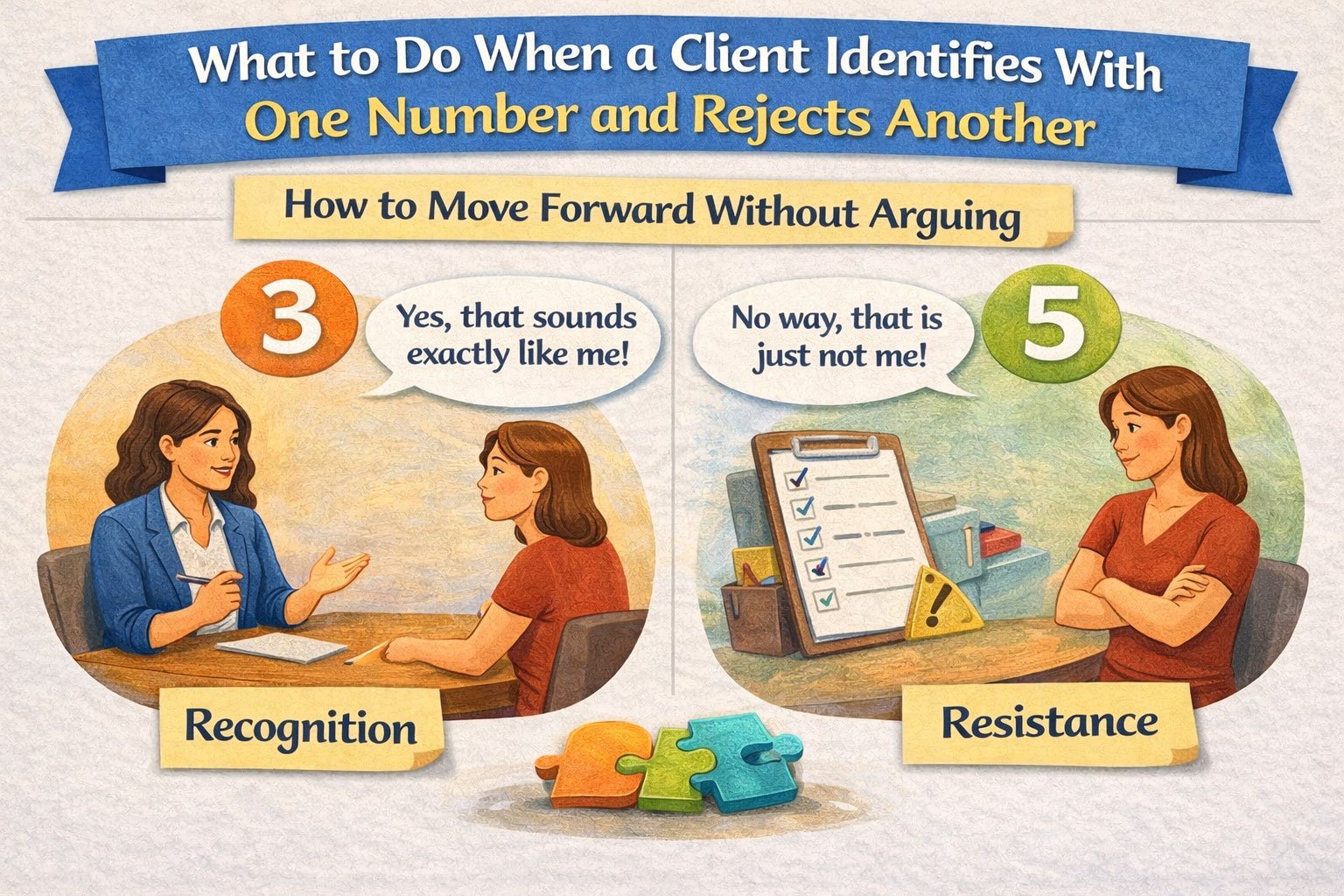
What to Do When a Client Identifies With One Number and Rejects Another Without Arguing

What to Do When a Client Identifies With One Number and Rejects Another Without Arguing

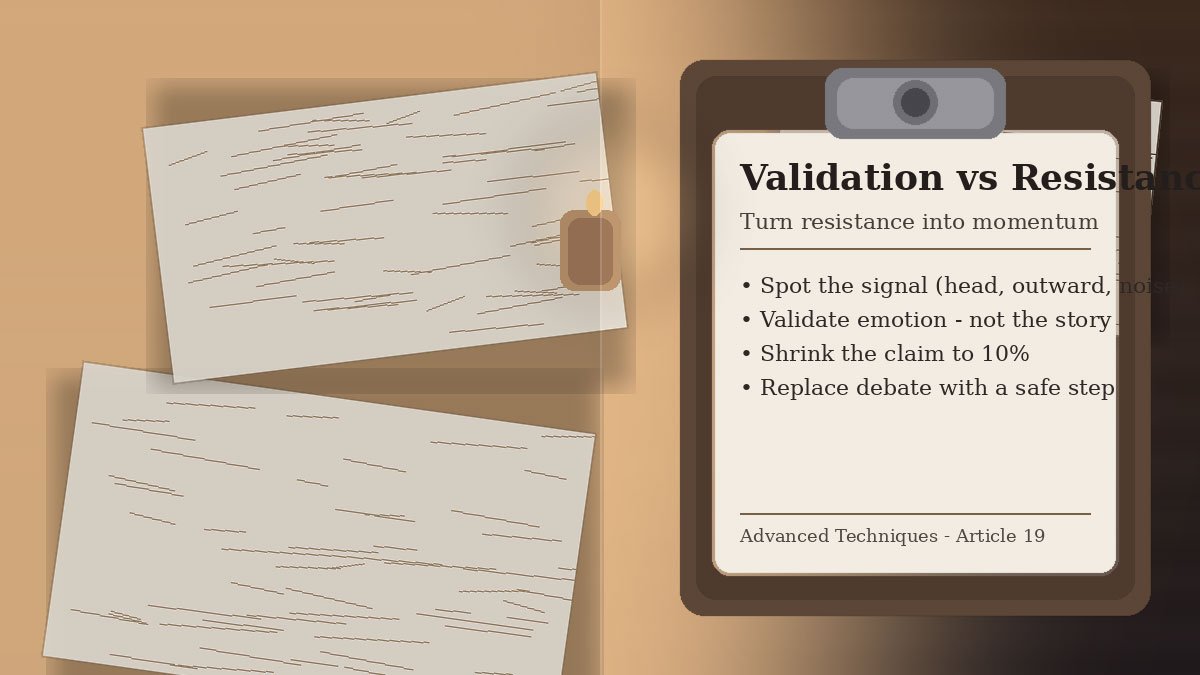
Strong readings often meet resistance: the client identifies with one number and rejects another. This article shows how to treat resistance as information, not failure. You learn five common resistance sources (judgmental language, identity threat, shame, blind spots, dormant themes) and the PNA 4-step script: validate, clarify, reality test, practice. You also get word-swap and dosage techniques, clinic-ready lines, and a full case example showing how to move from "that’s not me" into measurable work without argument.

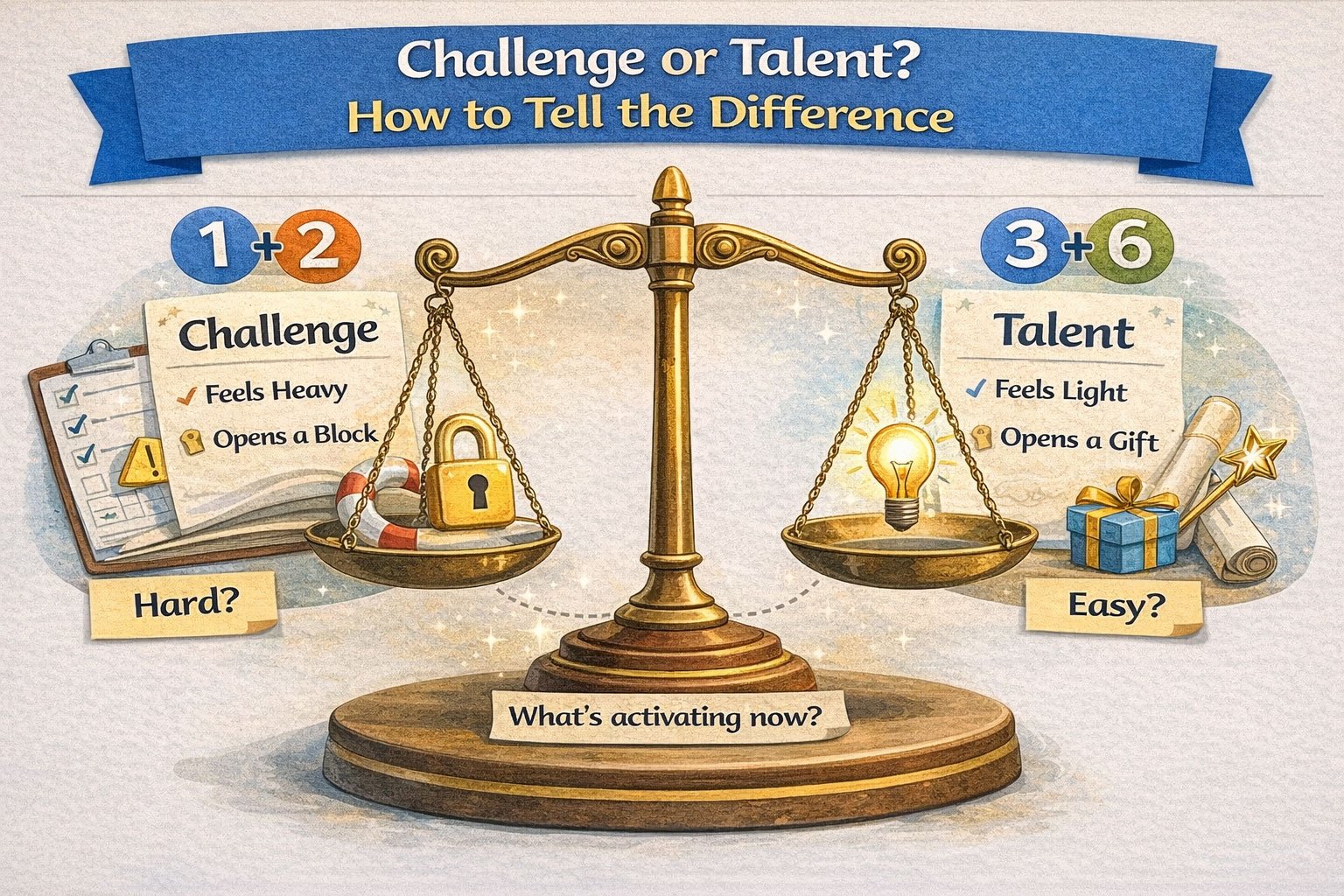
How to Separate Talent From Challenge When Two Numbers Sound Similar

How to Separate Talent From Challenge When Two Numbers Sound Similar

When two numbers sound similar, it’s easy to fall into confusion: is it "double talent" or "double problem"? This article teaches a PNA method that separates talent from challenge through four tests (flow, outcomes, cost, stress response) and three clear scenarios (talent amplification, challenge amplification, high output with high cost). You also get practical techniques to split the same label into two different mechanisms, a one-scene proof method, a weekly field test that settles doubt, and a full case study showing how real strengths stay powerful without turning into burnout.

Case Studies That Make Every Combination Real

Case Studies That Make Every Combination Real

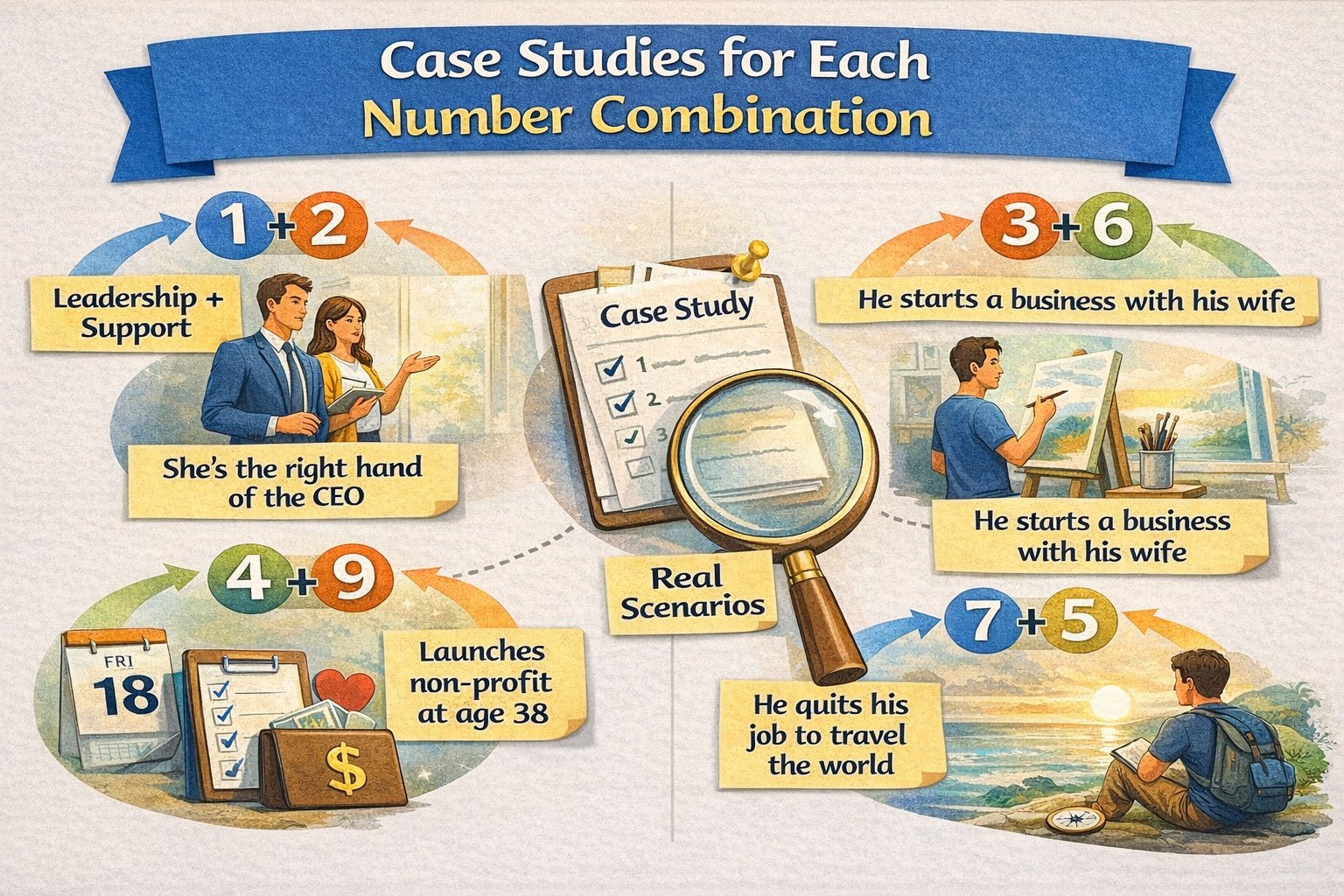
Clients don’t get convinced by interpretations. They get convinced by examples that prove accuracy. This article gives you a professional PNA case-study template and eight full combination cases showing real triggers, real costs, and one measurable practice that balances the system. You also learn how to choose the one story that fits the client, how to tell it without shame or drama, and how to end with an action sentence that creates change. It turns "combination reading" from diagnosis into a practical working story.

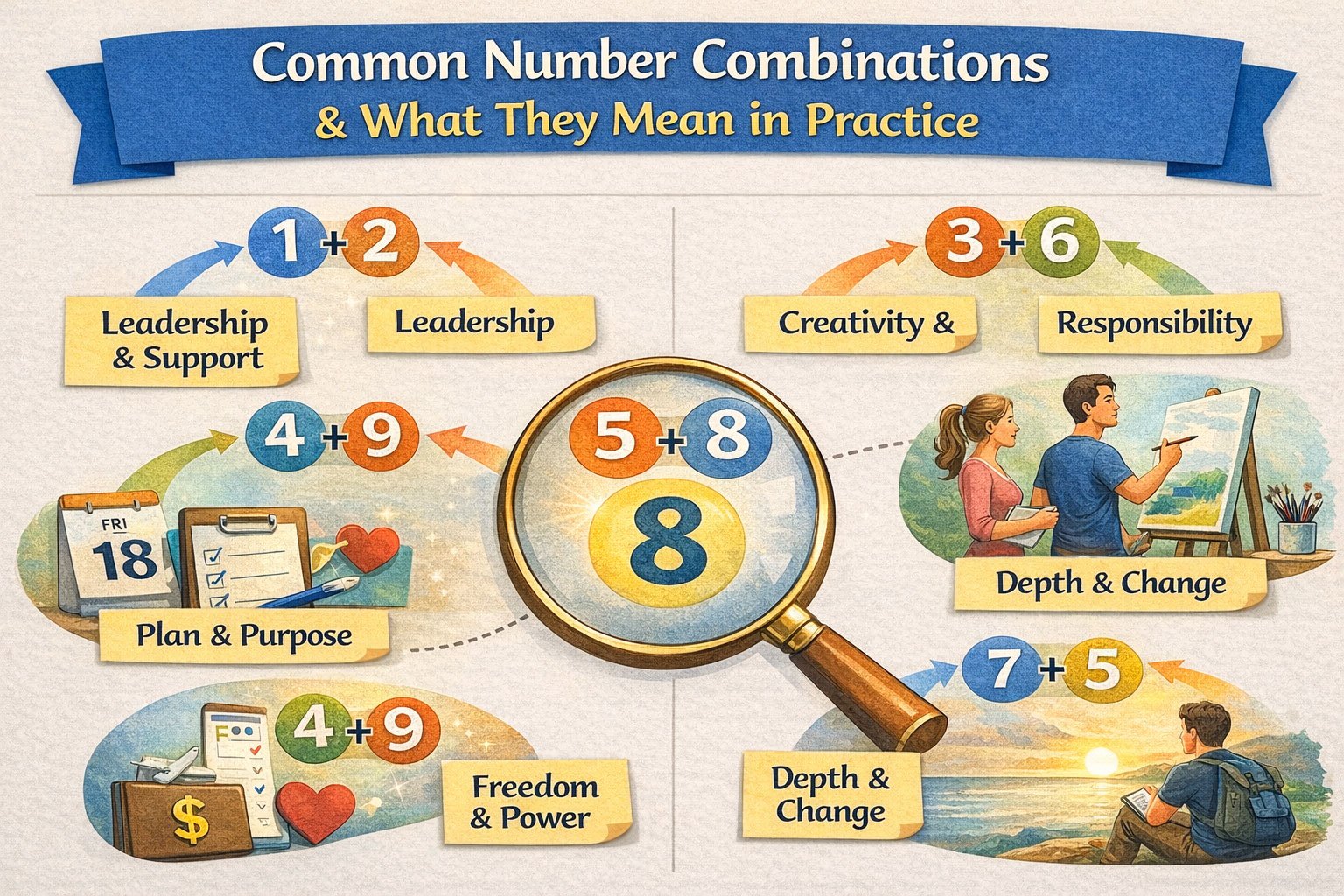
Common Number Combinations - and What They Mean in Real Life

Common Number Combinations - and What They Mean in Real Life

Combinations are where a reading becomes sharply personal, or painfully overwhelming. This article teaches a PNA model for reading combinations: one headline that holds the story, lead vs secondary engines, the inner tension, real daily-life scenes, and a measurable practice that balances the system. You also get a bank of common combinations with practical corrections, clinic-ready lines, and client summary templates. It turns "I’m both this and that" into one method that creates results.

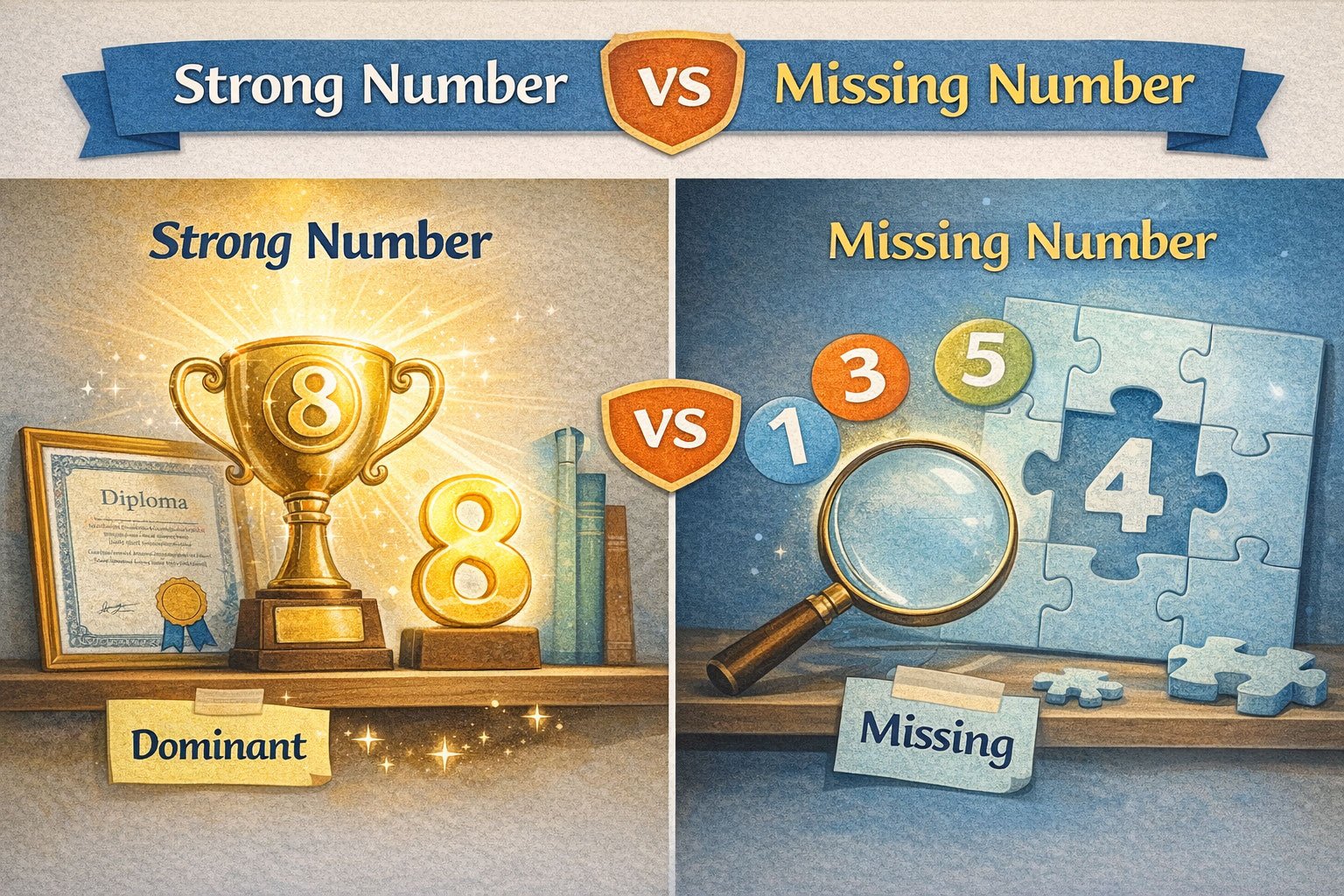
Strong vs Missing Numbers: How to Explain It Without Confusion

Strong vs Missing Numbers: How to Explain It Without Confusion

Strong and missing numbers are not grades. They are volume. This article shows how to explain strong vs missing without confusion or shame: what strong and missing actually mean, why strong needs boundaries and missing needs practice, how to identify whether missing is availability, fear, or confusion, how to turn the insight into one measurable weekly plan, which common strong-missing dynamics show up again and again, and how to move clients from "defect" into "tool." It turns a reading from description into action.
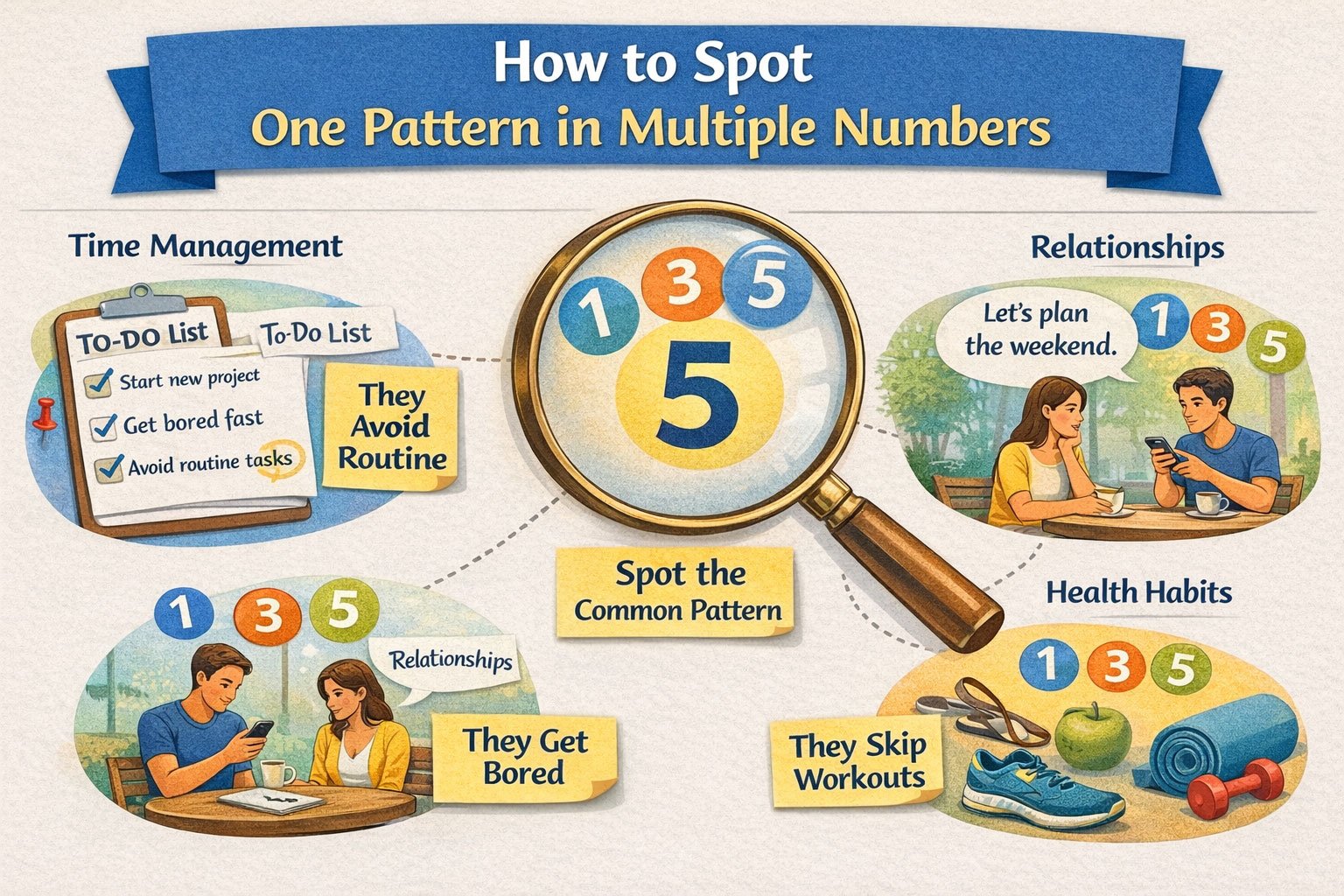
One Pattern Across Multiple Numbers: How to Spot It

One Pattern Across Multiple Numbers: How to Spot It

Most clients do not contradict themselves - they simply cannot see the repeating umbrella pattern across their numbers. This article teaches how to spot repetition through recurring words, cross-domain behavior, and one functional sentence. You get a bank of common patterns with practical translations, a plan template (trigger, cost, correction), ready-to-use clarity lines, and a case example showing how confusing numbers become one headline that drives action.

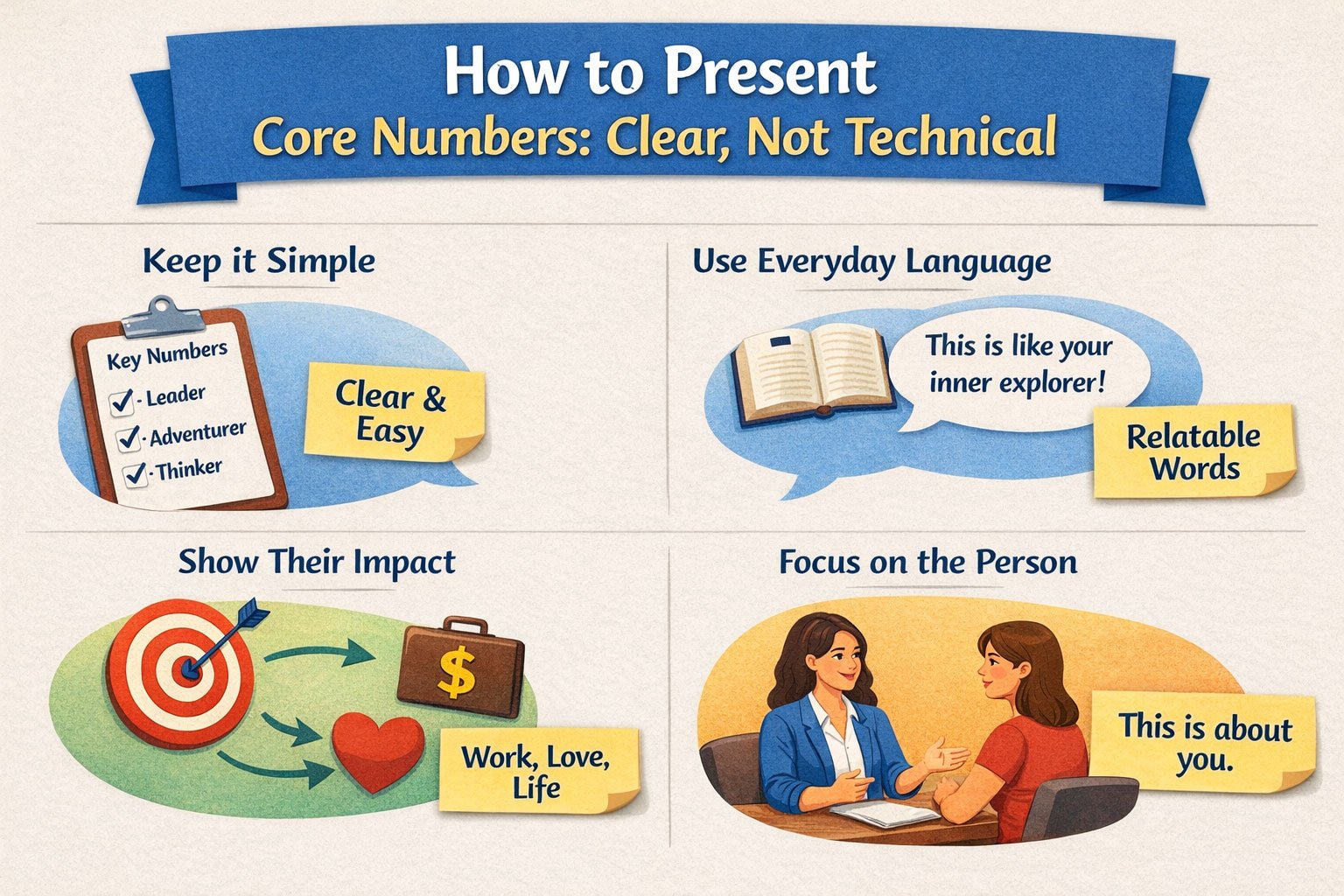
Presenting Core Numbers Clearly - Without Technical Talk

Presenting Core Numbers Clearly - Without Technical Talk

Most clients are not confused by numbers. They are confused by language. This article teaches how to present core numbers clearly and without technical talk: start with meaning instead of math, deliver one message at a time, use a 3-layer model with real-life situations, replace jargon with professional human language, build a story with a clean order, calibrate with diagnostic questions, and end with one measurable action. This turns "I have many numbers" into a simple path that creates results.


Pricing and Salary Negotiation: Value Language, Boundaries, Terms

Pricing and Salary Negotiation: Value Language, Boundaries, Terms

Pricing and salary negotiation are not technical topics. They are where money meets self-worth, fear, and boundaries. This article teaches how to read pricing patterns through numerology (2, 6, 7, 8, 4, 5, 9, 1, 3), build value language that replaces apology with clarity, define boundaries and terms that prevent burnout and conflict, handle objections without fighting, and use timing strategy to know when to ask for more and when to build. This turns “I can’t charge” into a measurable process that creates results.

Money and Partnerships: Choose Partners, Build a “Human Contract”

Money and Partnerships: Choose Partners, Build a “Human Contract”

Partnership can multiply business or blow it up. This article teaches how to read partnerships through professional numerology: number combinations that often work (4+5, 7+3, 6+8, 1+2, 9+8), red-flag gaps that require agreements, and a practical PNA process that replaces “let’s try” with a clear protocol: a partnership interview, a 30-day pilot, a one-page human contract, and a decision with a review date. You also get five money rules that protect trust when pressure rises.

Money Cycles: How to Stabilize Highs and Lows

Money Cycles: How to Stabilize Highs and Lows

Money cycles are not destiny. They are a system. This article teaches a professional numerology approach to stabilizing income highs and lows: which numbers tend to create waves (5, 3, 1, 9) and which numbers stabilize (4, 8, 6, 2, 7), how Personal Year and Month timing selects the best actions, and how to build a simple stability engine with a three-account system, rules for highs and lows, and a dashboard that reduces panic. This turns money from something that controls the client into something the client can manage.

Money as an Emotional Response: Fear, Control, Self-Worth

Money as an Emotional Response: Fear, Control, Self-Worth

Money is not only a bank number. It is an emotional response. This article shows how professional numerology reads money patterns through three primary axes: fear, control, and self-worth. You get a deep number-to-pattern map (8, 4, 5, 6, 7, 9, 1, 2, 3), learn how contradictions between Life Path, Expression, and Heart create money “short circuits,” use timing strategically (Personal Year themes) to choose the right focus, and apply a clear four-step protocol: one boundary, one practice, one metric, and a review date. This turns money readings into measurable change.

Perfectionism and Burnout: Mechanism, Triggers, Balance

Perfectionism and Burnout: Mechanism, Triggers, Balance

Perfectionism and burnout are not personality traits. They are protective mechanisms that activate when truth, responsibility, care, or outcomes collide with fear of visibility and mistakes. This article teaches you how to read the pattern through numerology (7, 4, 8, 6, 2, 3), recognize burnout signals before the crash, use timing strategically (Personal Year themes), and apply a clinic-ready PNA protocol: release standards, minimum execution, recovery boundaries, and measurable metrics. This turns “perfect or nothing” into stable progress.

Success Blocks: Fear of Visibility, Fear of Money, Fear of Responsibility

Success Blocks: Fear of Visibility, Fear of Money, Fear of Responsibility

Clients do not get stuck because they lack information. They get stuck because a protective block activates at the exact point that matters most: visibility, money, or responsibility. This article teaches you how to read success blocks through professional numerology without blame: translate number tensions into protective patterns, use timing strategically (Personal Year themes), and turn each block into a measurable action system (small action, frequency, metric, and boundary). This is career numerology that creates real movement.

Building a 90-Day Path: Goals, Habits, Metrics

Building a 90-Day Path: Goals, Habits, Metrics

A strong career reading does not end with inspiration. It ends with execution. This article shows you how to build a 90-day path that matches the numerology profile: pace, work style, motivation drivers, and burnout risks. You get a clear 30-30-30 structure, track templates for employment, services, and scalable products, a simple 5-metric dashboard, timing-based emphasis guidance (Personal Year and Month), and client-ready scripts and templates to turn insights into measurable progress.

Employee vs Self-Employed: How to Choose Without Fantasy or Fear

Employee vs Self-Employed: How to Choose Without Fantasy or Fear

Employee vs self-employed is not a personality decision. It is a structure decision. Professional numerology identifies what you need to stay consistent (Heart’s Desire), how you execute in the real world (Expression), and your growth pace (Life Path), then connects it to real-life constraints and timing strategy. This article gives you a full PNA framework: four work models, number-based risk patterns, timing as strategy, clinic-ready questions, micro-dialogues, and a 90-day transition plan built on experiments and metrics. This is career numerology that produces proof, not fantasy and fear.

Helping a Client Choose Between 2-3 Career Options

Helping a Client Choose Between 2-3 Career Options

When a client is stuck between 2-3 career options, they want a sharp answer. A professional numerology reader builds a regret-minimizing decision: numerology work-style fit, real-life conditions, timing strategy, and a short experiment with a measurable metric. This article gives you a clinic-ready decision matrix, practical number-to-fit translations, ethical timing as a tiebreaker, and 14-day experiment templates for each option. This is a career reading that produces a decision process, not a prophecy.

Purpose vs Profession: How to Translate Depth into a Practical Path

Purpose vs Profession: How to Translate Depth into a Practical Path

Most people get stuck on “what is my purpose” and wait for a magical answer. Professional numerology does not hunt for one perfect job. It builds a path: work style, conditions, a short experiment, and a clear metric. In this article you learn how to separate purpose, talent, and role, how to use Life Path, Expression, Heart’s Desire, and timing as practical planning tools, and how to apply a 6-step PNA model that turns depth into a real 14-day experiment and a 90-day direction. This is career numerology that produces action and proof, not fantasy and promises.
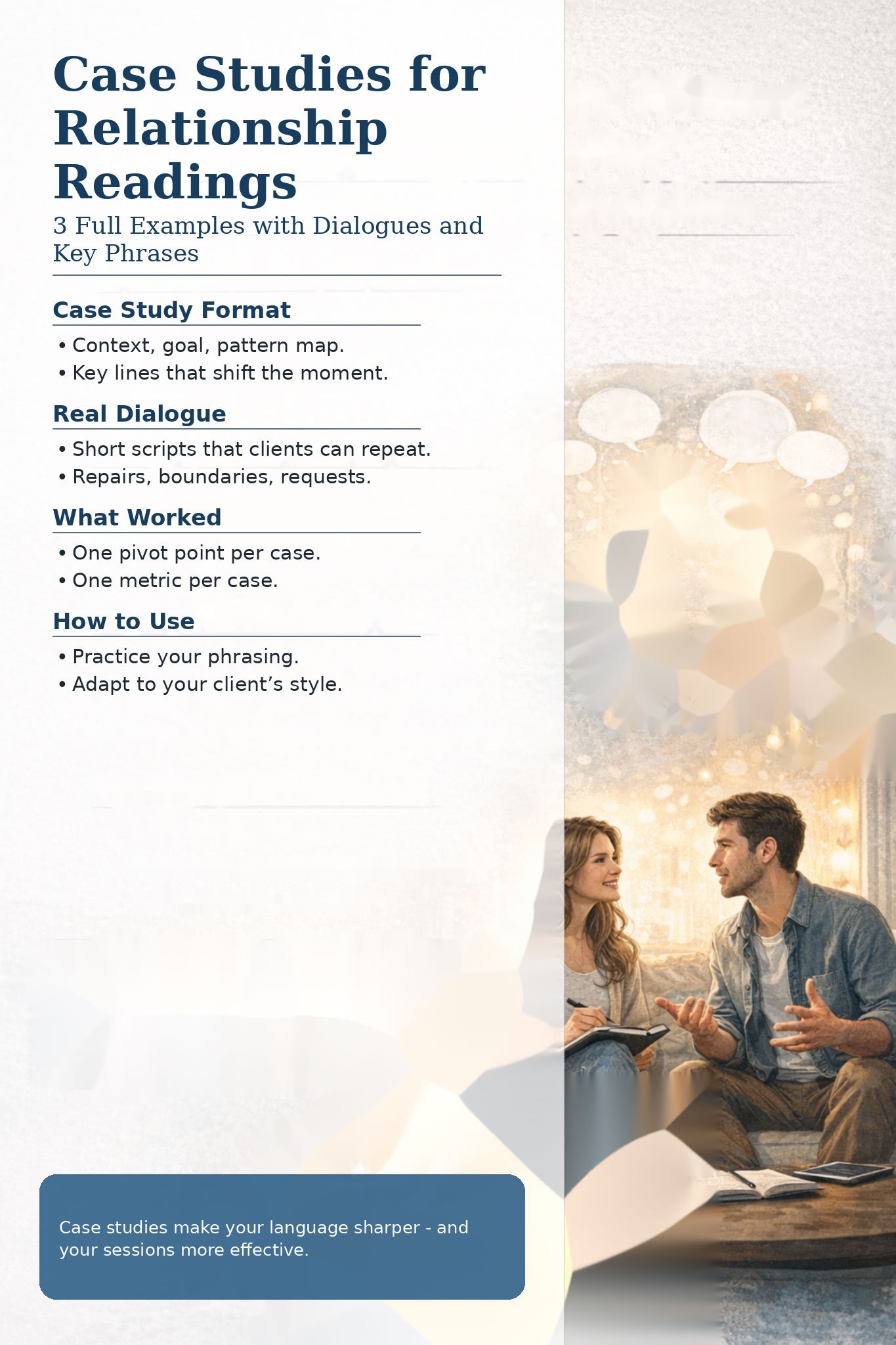
3 Real-Life Case Studies: Full Examples With Dialogue and Key Phrasing

3 Real-Life Case Studies: Full Examples With Dialogue and Key Phrasing

Three real-life case studies that demonstrate professional relationship readings through numerology: pursuit-avoidance, criticism-defensiveness, and a level-up decision (moving in). Each case shows a number map translated into dynamics (not labeling), practical dialogue with key phrasing, a short action plan, clear metrics, and a client-ready written summary template. This is the PNA standard: pattern plus timing that leads to change, not prophecy.

How to Link Timing to a Core Pattern Instead of Giving Generic Predictions

How to Link Timing to a Core Pattern Instead of Giving Generic Predictions

Generic predictions about Personal Years and Personal Months sound good, but they are not precise and not very useful. Professionals link timing to the client’s core pattern, and timing becomes a real decision tool. This article teaches you how to identify patterns quickly with 12 questions, map common unbalanced tendencies in 1-9 energies without labeling, understand how the same timing can work in opposite ways for different people, and build corrective behavior with one action and one metric. This is timing tailored to the person, not to a textbook.

Ethics of Timing: Where the Line Is Between Timing and Promises

Ethics of Timing: Where the Line Is Between Timing and Promises

Timing without ethics quickly becomes guarantees, fear, and dependency. Professional timing does the opposite: it strengthens autonomy, defines conditions, and returns power to the client through action and a measurable metric. This article shows you where the line is between timing and promises, the signs you are sliding into absolute language, seven ethical rules for professional timing, safe phrasing for sensitive situations, and a client-ready closing template that prevents dependency and creates a real process.

Timing and Warnings: How to Talk About Risk Without Fear or Self-Fulfilling Prophecy

Timing and Warnings: How to Talk About Risk Without Fear or Self-Fulfilling Prophecy

Warnings are where timing can destroy trust and create anxiety. Professionals don’t predict disaster - they manage risk. This article teaches an ethical, practical system for discussing risk: seven language rules, forbidden vs professional phrasing examples, a Low-Medium-High risk rating model, how to identify where risk actually comes from (timing mismatch, behavior pattern, nervous system load), and how to build a 7-day protection plan with one action and one metric that calms and moves the client forward. This is timing that creates safety, not fear.

Action Language for Every Season: How to Turn Timing into Weekly Tasks and Metrics

Action Language for Every Season: How to Turn Timing into Weekly Tasks and Metrics

The difference between “interesting” numerology and professional timing is the ability to translate timing into action and a measurable metric. Without that, clients get a nice interpretation, not change. This article gives you a universal timing-to-action template, professional phrase banks, weekly tasks and metrics for numbers 1-9, recommended metrics by domain (relationships, business, money, health), and practical examples. It turns timing into a real working tool.

Turning Points Inside the Year: How to Identify Critical Weeks Without Creating Drama

Turning Points Inside the Year: How to Identify Critical Weeks Without Creating Drama

Turning points inside the year are a powerful timing tool, but only when used without drama. Instead of “a fated week,” we identify weeks where behavior shifts create outcome shifts. This article teaches three professional methods to find critical weeks (Personal Month shifts, Personal Day clusters, and a simple weekly map), safety rules that prevent fear and dependency, a clean turning point model, and real examples across career, relationships, and money with one action and one measurable metric.

Decision Windows: When Big Moves Are Most Suitable

Decision Windows: When Big Moves Are Most Suitable

Decision windows are the professional way to answer “when” without fear and without promises. Instead of hunting for a perfect day, you identify a usable window, define conditions, and act with one metric. This article gives you a complete system: the three window types (start, commitment, closure), the Year-phase-Month-Day layering method, the Green-Yellow-Red rating approach, full examples for work, relationships, and money, and client-ready templates you can use immediately.

Timing by Goal: How to Choose the Right Timing Tool for the Question

Timing by Goal: How to Choose the Right Timing Tool for the Question

Most people ask “When,” but professionals first ask “Why” and “What is the goal?” This article teaches you how to choose the correct timing tool by question type and domain: when to use Personal Year vs Personal Month vs Personal Day, how to apply a practical decision matrix for career, money, and relationships, how to avoid common mistakes that create confusion, and how to end every timing session with one action, one metric, and a review date.

How to Identify Change Seasons vs Building Seasons

How to Identify Change Seasons vs Building Seasons

One of the most important timing skills is knowing whether a client is in a change season or a building season. Getting this wrong is expensive. This article teaches you how to identify the season using three layers (reality, core pattern, and timing), which Personal Years tend toward change vs building, how to interpret confusing combinations like Year 5 inside Pinnacle 4, and two professional action frameworks (a 14-day change plan and a 30-day building plan) with metrics. This is timing that produces better decisions, not fear.

Dual Timeline Method: How to Combine Personal Year, the 9-Year Cycle, and Pinnacles & Challenges

Dual Timeline Method: How to Combine Personal Year, the 9-Year Cycle, and Pinnacles & Challenges

Most people throw multiple cycles at clients and create confusion. Professionals build one clear timeline. This article teaches you how to combine Personal Year, the 9-year cycle, and Pinnacles & Challenges without contradictions: which layer manages the season, which layer defines the project phase, which layer defines execution, how to spot the dominant layer, and how to close with one weekly action and one metric. This turns numerology timing into a real decision tool, not a pile of interpretations.

Personal Year, Personal Month, Personal Day - When to Use Which

Personal Year, Personal Month, Personal Day - When to Use Which

Personal Year, Personal Month, and Personal Day are three different tools. Used correctly, timing becomes a clear process instead of a vague prediction. This article teaches you how to choose the right timing resolution by question type, when each layer is strongest, which mistakes to avoid, and how to connect year-month-day into one actionable plan with a measurable metric. That is what makes professional numerology timing practical, ethical, and genuinely helpful without scaring clients.

Timing Foundations: How to Work With Time Without Scaring People

Timing Foundations: How to Work With Time Without Scaring People

Timing is one of the most powerful tools in numerology, and also one of the most dangerous when it becomes fear or prophecy. This article teaches a professional, ethical way to work with time: what timing is and isn’t, key ethics rules, a 4-layer model for building timing readings without drama, how to neutralize client fear by understanding pattern-based stress needs, and how to end every timing session with one action and one metric that creates real results.

3 Case Studies: Full Professional Examples with Dialogue, Key Phrasing, and Numerology Translation

3 Case Studies: Full Professional Examples with Dialogue, Key Phrasing, and Numerology Translation

Want to see what professional relationship readings look like in real life? This article delivers three full case studies with extended dialogue, loop mapping, key questions, deep numerology translation (Life Path, Destiny/Expression, Soul Urge, Personality, Birthday), and a clear weekly task with measurable metrics for each case. You’ll learn how to work without blame, without labels, and without prophecy, while still producing real behavioral change clients can track week by week.

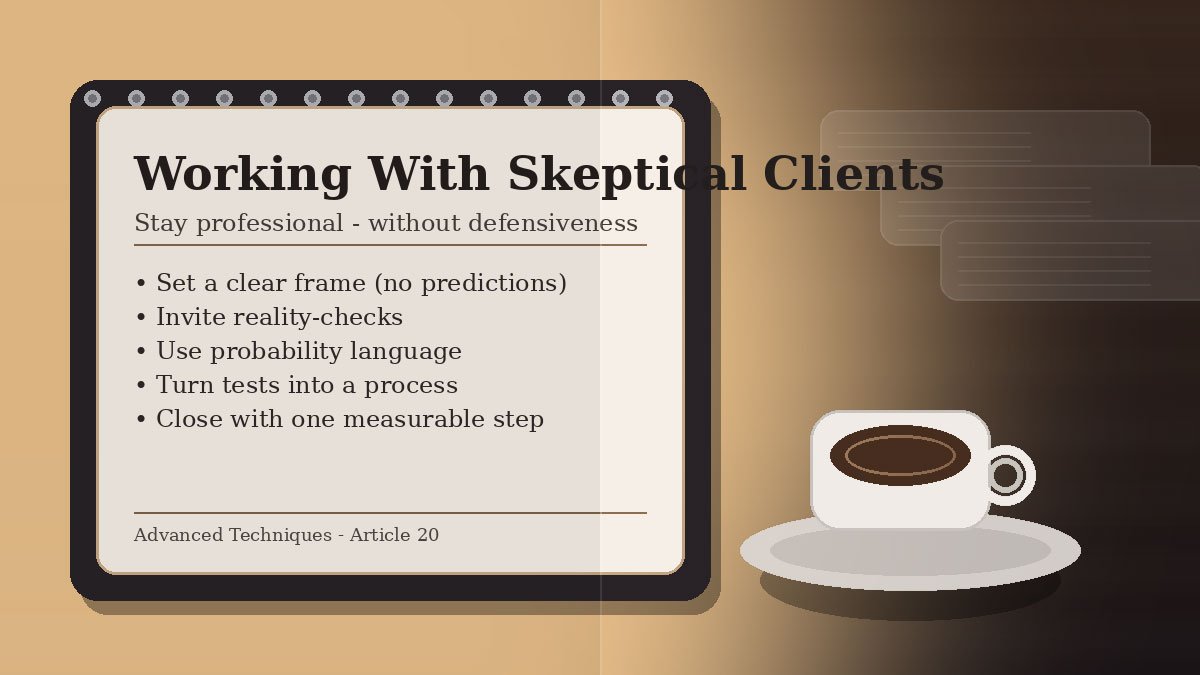
When One Partner Is Skeptical or “Dragged In”: How to Work Without a Power Struggle

When One Partner Is Skeptical or “Dragged In”: How to Work Without a Power Struggle

When one partner is skeptical or feels dragged in, most practitioners try to persuade them and create a power struggle. This article gives a professional framework that works without convincing: a resistance-reducing opening contract, a clear 30-60 minute session structure, ready-to-use scripts, and low-friction weekly tasks with simple metrics. It also includes deep numerology-based personalization (Life Path, Destiny/Expression, Soul Urge, Personality, Birthday) to understand how different types resist and what calms them, so even the skeptic leaves with a measurable action plan instead of an argument about belief.

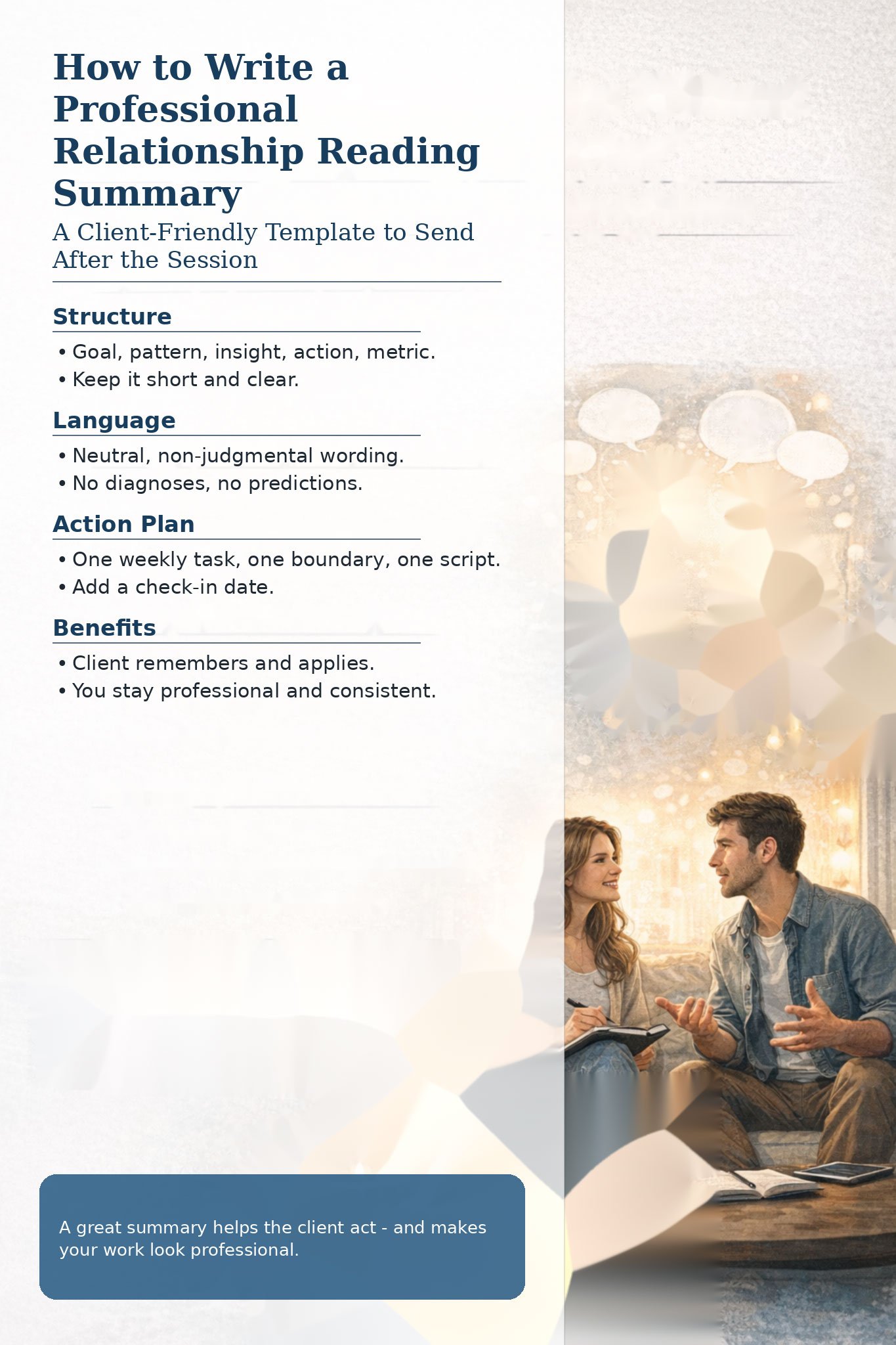
How to Write a Professional Relationship Reading Summary: A Client-Ready Template

How to Write a Professional Relationship Reading Summary: A Client-Ready Template

A written summary is the difference between a powerful session and a real process. This article gives you a client-ready copy-and-paste template for professional relationship reading summaries, ethical writing rules (describe don’t diagnose, no blame, no prophecy), short examples for common patterns, and a numerology section that translates Life Path, Soul Urge, and Destiny/Expression into practical weekly tasks and measurable metrics. It’s the tool that turns you from an interpreter into a process leader.

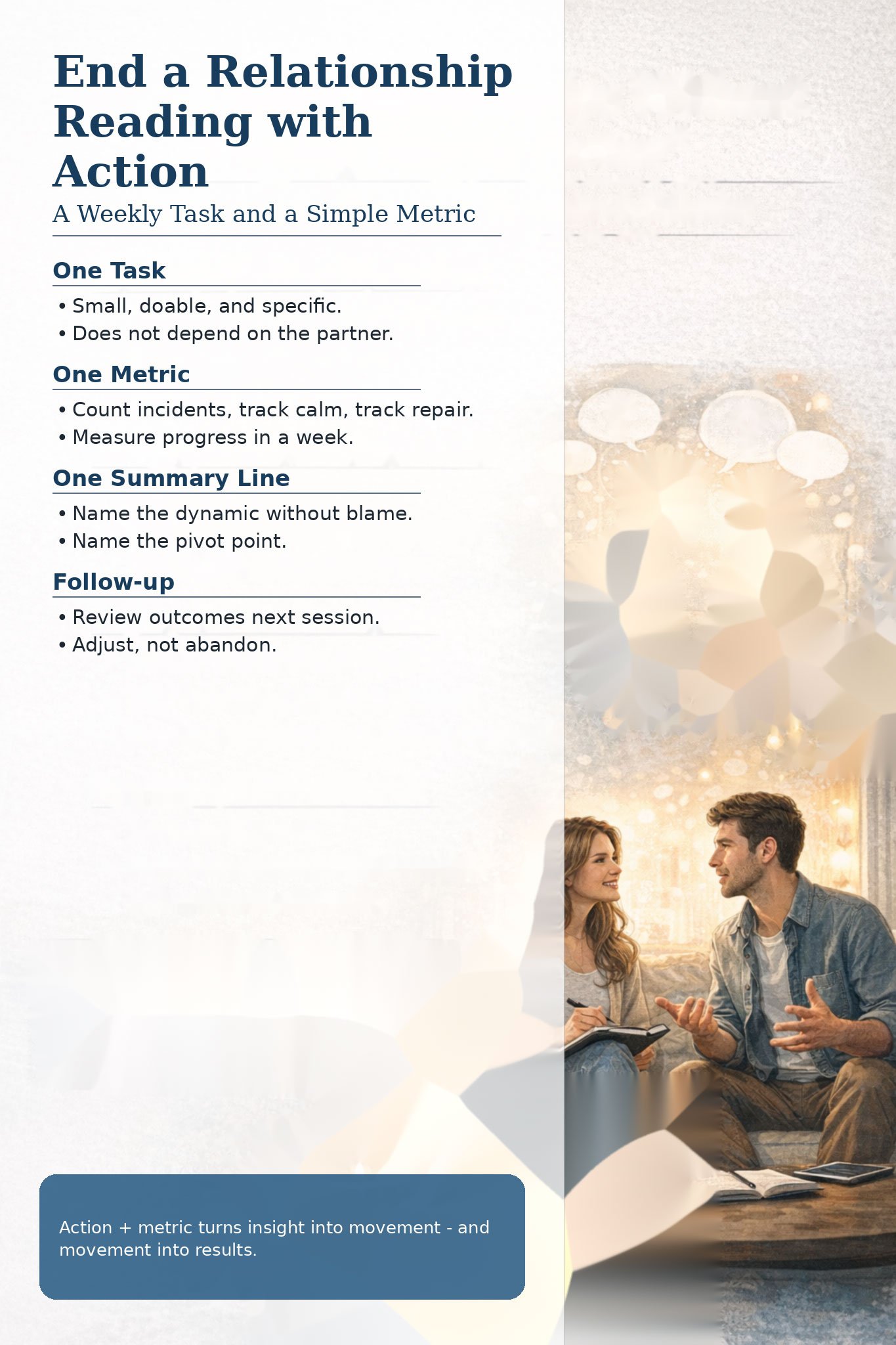
How to End a Relationship Reading with Action: One Weekly Task and One Metric

How to End a Relationship Reading with Action: One Weekly Task and One Metric

Most relationship readings fail at the ending. This article gives you a professional closing framework that always ends with action: one weekly task, one clear metric, and a short summary script that supports real process. It includes deep numerology-based personalization using Life Path, Soul Urge, and Destiny/Expression so clients choose tasks they can actually execute, plus practical closing examples for the most common relationship patterns.

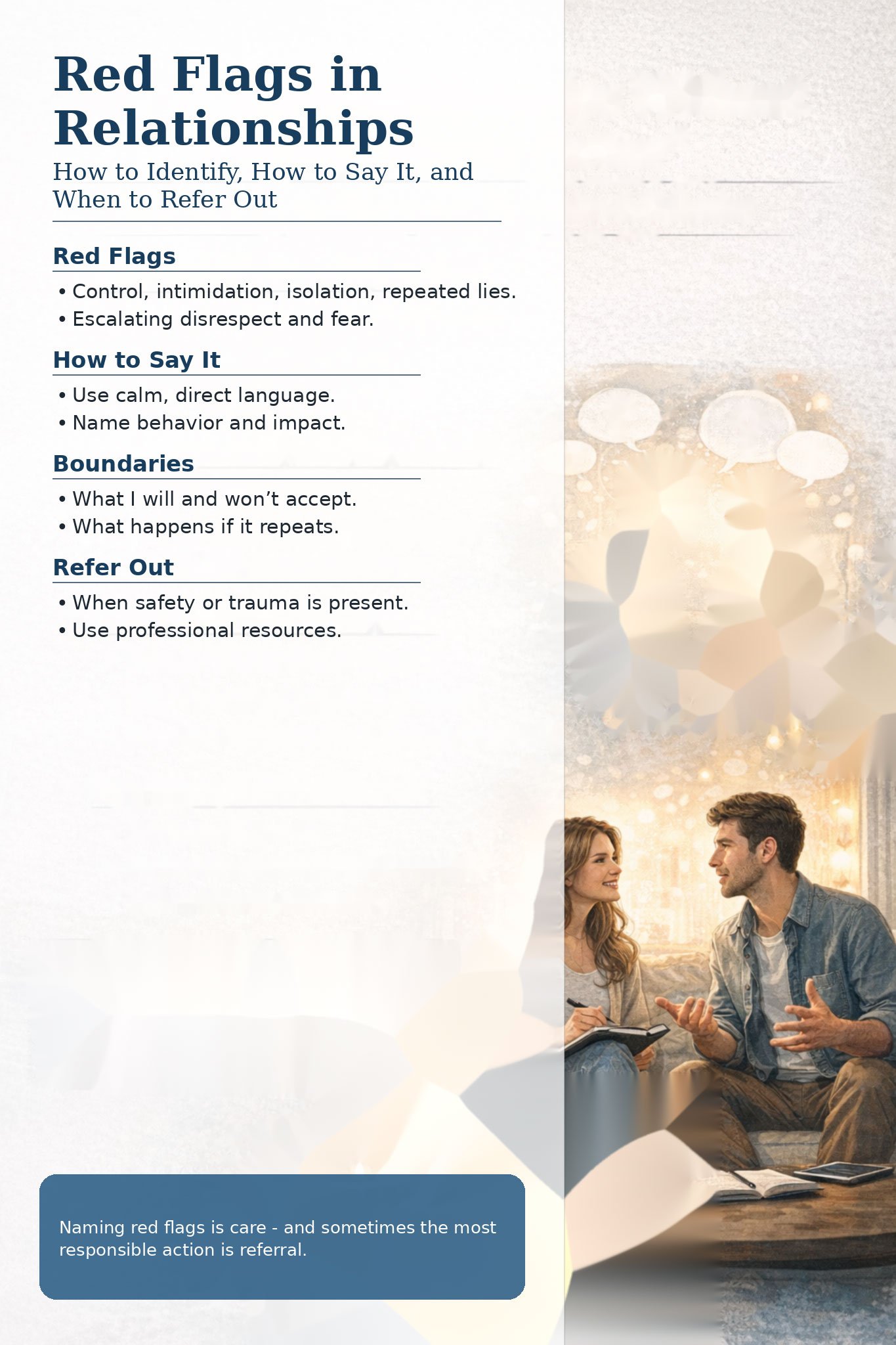
Red Flags in Relationships: How to Identify Them, How to Say It, and When to Refer Out

Red Flags in Relationships: How to Identify Them, How to Say It, and When to Refer Out

Red flags are where professionalism is proven. This article teaches a three-level red-flag model (difficulty, harm, danger), shows how to use numerology responsibly without excusing abusive behavior, provides red-flag lists by category, gives clear language for naming patterns without labels or drama, and explains when and how to refer out. Includes a 14-day boundary-and-reality experiment with measurable metrics that helps clients regain safety and agency.

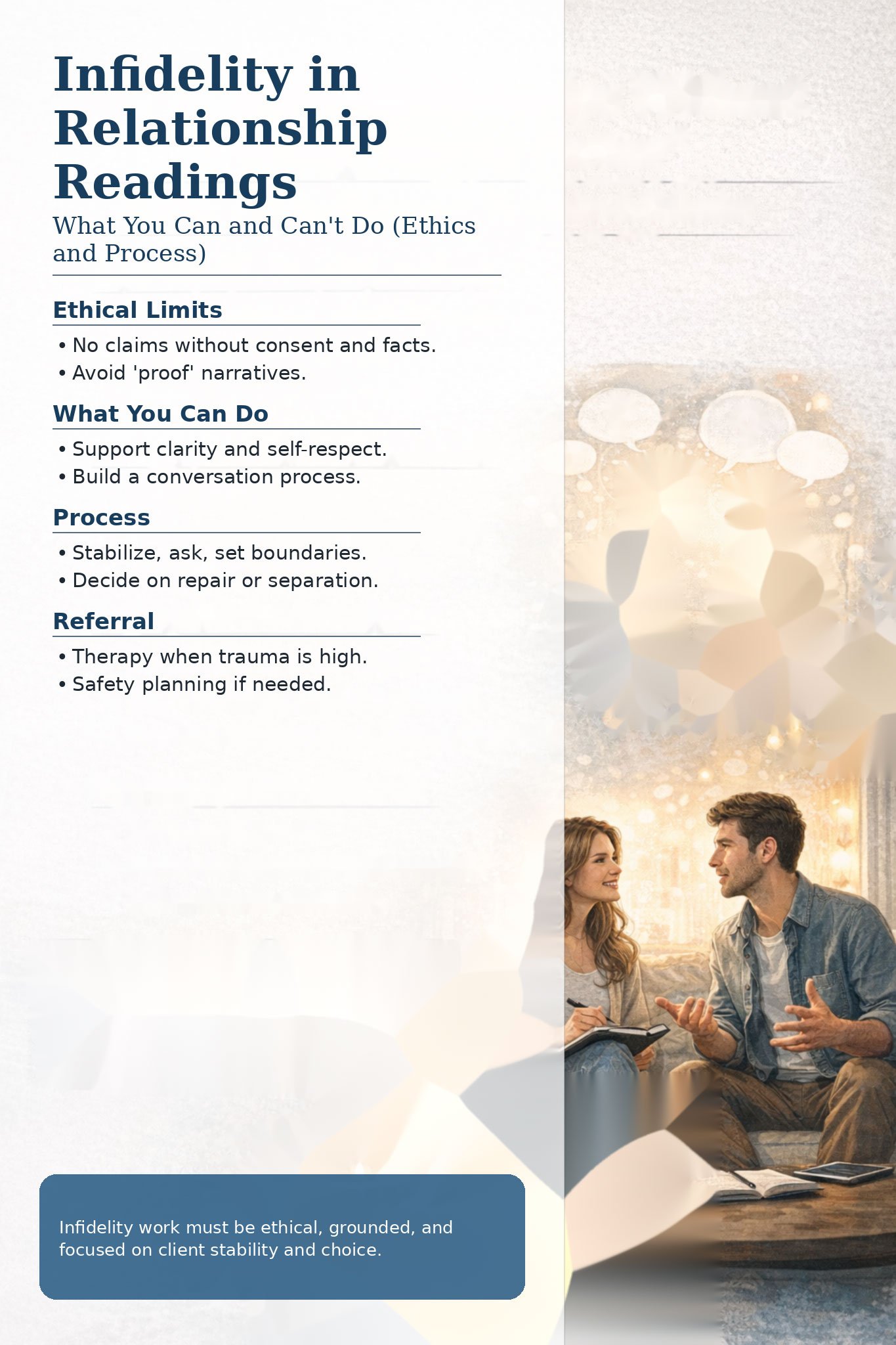
Infidelity: What You Can Do in a Reading and What You Must Not Do

Infidelity: What You Can Do in a Reading and What You Must Not Do

Infidelity requires ethics, structure, and real process. This article explains what you must not do in a reading (no declaring without evidence, no surveillance encouragement, no third-party reading, no revenge permission) and what you can do professionally: stabilization, reality testing, boundary design, a 5-step conversation protocol, two legitimate pathways (repair with conditions or closure), and a detailed 30-day repair experiment with measurable trust metrics. Includes deep numerology (Life Path, Destiny/Expression, Soul Urge, Personality, Birthday plus 11/22/33) to map safety needs, stress reactions, and repair style without feeding paranoia.

Jealousy and Suspicion: The Root Pattern and How to Work Without Feeding Paranoia

Jealousy and Suspicion: The Root Pattern and How to Work Without Feeding Paranoia

Jealousy and suspicion are not healed by investigation. They’re healed through safety, boundaries, and process. This article teaches how to separate intuition from anxiety, identify three jealousy types, and work professionally with deep numerology (Life Path, Destiny/Expression, Soul Urge, Personality, Birthday plus 11/22/33). You’ll get a non-paranoia protocol, diagnostic questions, practical no-drama scripts, and a detailed 21-day experiment with measurable outcomes that creates real change without feeding paranoia.
Breakups, Reconnection, and Unhealthy Relationships: How to Work Without Drama

Breakups, Reconnection, and Unhealthy Relationships: How to Work Without Drama

Breakups and reconnection are not fate. They are process. This article teaches a professional way to work with endings, pauses, and reconnection without drama through deep numerology (Life Path, Destiny, Soul Urge, Personality, Birthday), a 3-check decision protocol, 12 diagnostic questions, a 14-day reconnection experiment, and no-drama scripts that create boundaries and dignity. Instead of pain driving choices, you get a clear process that creates responsible decisions.

Second Chapter Relationships: Trust, Boundaries, Kids, and Role Sharing

Second Chapter Relationships: Trust, Boundaries, Kids, and Role Sharing

Second chapter relationships are systems: children, co-parenting, money, boundaries, and trust. This article gives a detailed professional process with deep numerology (including 11/22/33): how to spot landmines early, define roles with kids, set healthy boundaries with an ex without drama, build money and load agreements, use a conflict-repair protocol, and run a 30-day experiment with measurable outcomes that create real stability in a blended family.

Moving In, Marriage, or Kids: How to Work With a Decision Season

Moving In, Marriage, or Kids: How to Work With a Decision Season

A decision season does not have to turn into pressure and avoidance. This article teaches a clear professional process for moving in, marriage, or kids: deep numerology (Life Path, Destiny/Expression, Soul Urge, Personality, Birthday), a 4-area decision map, 12 key questions, a 15-minute micro-talk template, and a 30-day experiment with measurable outcomes. Instead of prophecy, you gain clarity, agreements, and real-world data to see whether the relationship is truly ready for the next stage.

Early Dating: How to Read Expectations and Pace Without Predictions

Early Dating: How to Read Expectations and Pace Without Predictions

Early dating doesn’t need prophecy. It needs a clear map of pace, expectations, and patterns. This article gives you a deep numerology framework (Life Path, Destiny, Soul Urge, Personality, Birthday) to understand what the client needs to feel safe, what triggers anxiety or escape, and how to talk about pace without scaring the relationship. You’ll learn stability metrics instead of text-interpretation, a short conversation template, ready-to-use text scripts, a mixed-signal protocol, and weekly tasks with measurable outcomes that create real clarity.

Relationship Pace: Who Moves Fast, Who Gets Anxious - and How to Manage Pace Gaps

Relationship Pace: Who Moves Fast, Who Gets Anxious - and How to Manage Pace Gaps

Pace gaps don’t mean who loves more. They show who calms through closure and who calms through space. This article teaches you how to identify the pressure-escape loop, use deep numerology (Life Path, Destiny, Soul Urge, Personality, Birthday) to understand triggers and calming needs, and apply the “Stations” model to create a healthy pace without locking in or running away. You’ll also get a short talk script, a space agreement, and weekly tasks with clear metrics that create real change.

Values Gaps vs Style Gaps: How to Tell the Difference - and What to Do With Each

Values Gaps vs Style Gaps: How to Tell the Difference - and What to Do With Each

Many couples stay stuck because they don’t separate values gaps from style gaps. This article gives you a fast diagnostic test, a deep numerology map (Life Path, Destiny, Soul Urge, Personality, Birthday) showing when style becomes values, and clear actions for each type of conflict: style gaps with agreements and weekly experiments, values gaps with boundaries and real decisions. You’ll also get a 5-minute conversation template plus weekly tasks and measurable metrics that turn relationship readings into real clarity.

Relationship Compatibility: How to Have a Responsible Compatibility Talk (Without a Hard “Yes/No” Verdict)

Relationship Compatibility: How to Have a Responsible Compatibility Talk (Without a Hard “Yes/No” Verdict)

Compatibility is not a hard yes/no. It’s the ability to manage differences without burning out. This article gives you a 4-layer professional compatibility map and shows how to use deep numerology (Life Path, Destiny, Soul Urge, Personality, Birthday) to understand what the client needs, what triggers them, and which agreements can turn gaps into connection. You’ll get a responsible talk template, 12 compatibility questions, and a weekly task with clear metrics that support better decisions.
A Hard Conversation Without Drama: A 5-Step Template for Responsible Talk

A Hard Conversation Without Drama: A 5-Step Template for Responsible Talk

Hard conversations become drama when they lack structure. This article gives you a 5-step responsible talk template plus a deep numerology map (Life Path, Destiny, Soul Urge, Personality, Birthday) that explains what triggers each side and what calms them. You’ll learn how to open without blame, make one request without control, use a pause with a return time, and close with metrics and a review date so the conversation becomes real relationship change.

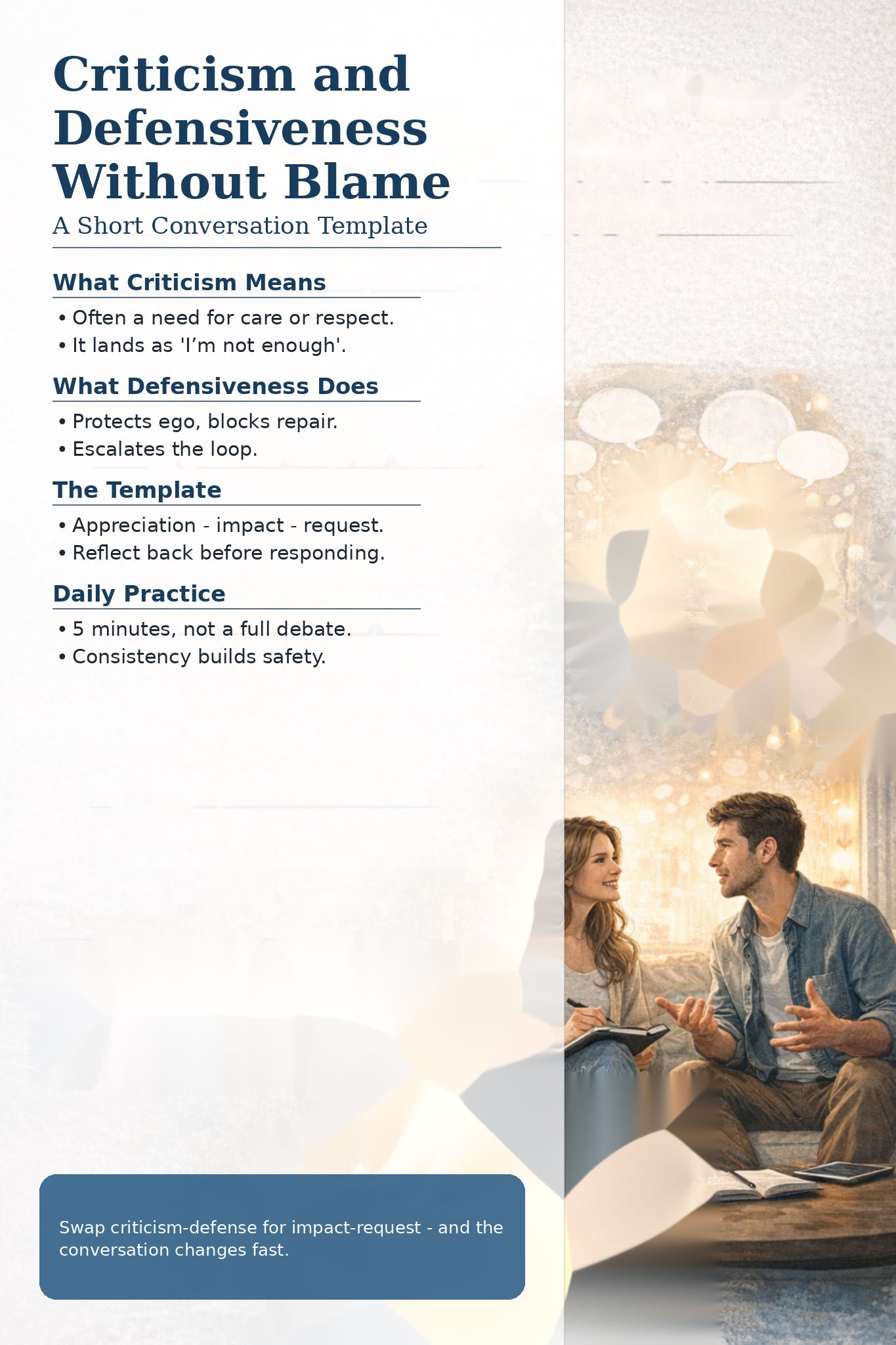
Handling Criticism and Defensiveness Without Blame: A Short Conversation Template

Handling Criticism and Defensiveness Without Blame: A Short Conversation Template

Criticism and defensiveness destroy relationships from the inside because they create shame instead of listening. This article gives you a one-minute conversation template that lowers heat fast, a deep numerology map (Life Path, Destiny, Soul Urge, Personality, Birthday) explaining why different people trigger criticism and defensiveness quickly, and practical tools to convert criticism into clean requests and respond without blame. You’ll also get a weekly task and measurable metrics to turn readings into real change.

How to Read a Fight: Trigger, the Fear Underneath, and the One Sentence That Lowers the Heat

How to Read a Fight: Trigger, the Fear Underneath, and the One Sentence That Lowers the Heat

The same fight repeats because people argue the topic instead of reading the loop underneath. This article teaches a professional way to read conflict: identify the trigger, uncover the fear beneath, use deep numerology (Life Path, Destiny, Soul Urge, Personality, Birthday) to translate styles and triggers, choose the one sentence that lowers the heat, and end every reading with a weekly task and clear metrics that create real change.

Communication Map: How to Help a Client Speak the Right Way for Their Pattern

Communication Map: How to Help a Client Speak the Right Way for Their Pattern

Most relationship fights are not about the topic - they are about language. This article shows you how to build a professional communication map that tracks trigger, reaction, and meaning, and uses deep numerology (Life Path, Destiny, Soul Urge, Personality, Birthday) to translate between styles. You’ll get de-escalation sentences, scripts by numbers, and a weekly task with measurable metrics that turn relationship readings into real change.

Chemistry vs Safety: Why a "Burning" Relationship Doesn’t Always Last - and What to Do

Chemistry vs Safety: Why a "Burning" Relationship Doesn’t Always Last - and What to Do

Chemistry and safety are different systems, and intense relationships don’t last without stability and repair. This article gives you a deep numerology map (Life Path, Destiny, Soul Urge, Personality, Birthday) to understand who seeks fire and who seeks safety, how to spot drama disguised as love, and how to build safety agreements without killing chemistry - with a weekly task and clear metrics.

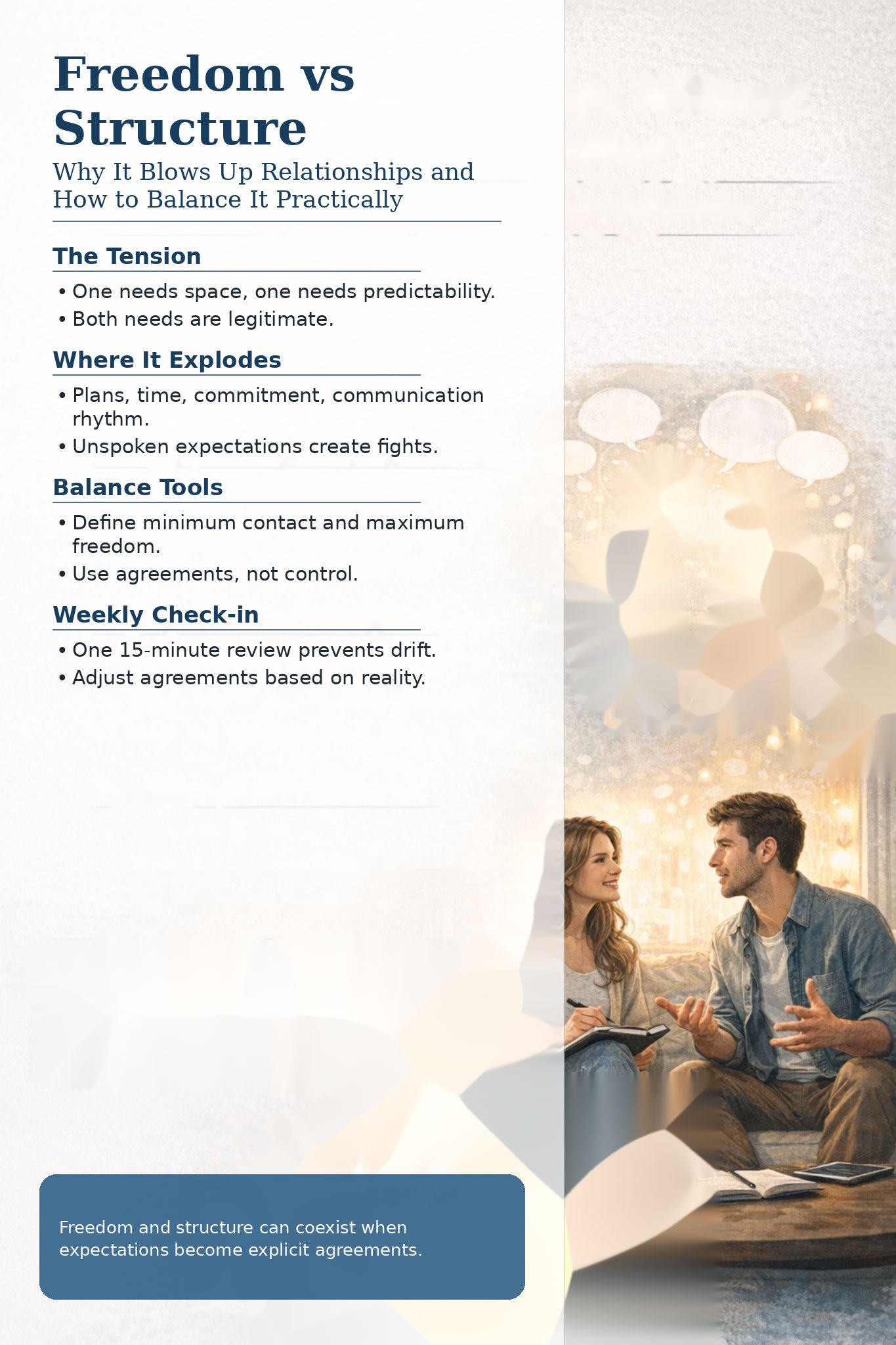
Freedom vs Structure: Why It Blows Up Relationships and How to Balance It Practically

Freedom vs Structure: Why It Blows Up Relationships and How to Balance It Practically

Freedom vs structure is one of the most explosive relationship gaps, often disguised as fights about texting, time, and planning. This article gives you a practical numerology map (Life Path, Destiny, Soul Urge, Personality, Birthday) to translate safety needs into clear agreements, plus ready-to-use scripts, a weekly task, and measurable metrics that turn relationship readings into real results.

People-Pleasing vs Boundaries: How to Spot It and Build a Boundary Without Hurting the Relationship

People-Pleasing vs Boundaries: How to Spot It and Build a Boundary Without Hurting the Relationship

People-pleasing looks like peace, but it builds resentment and burnout. This article helps you spot people-pleasing in minutes, understand what it protects, and build a short clean boundary that doesn’t damage connection. You’ll get scripts, boundary types, practice steps, and a weekly task with a metric to turn relationship readings into real change.

Pursuer-Withdrawer (Distance-Dependency): Explain It Without Labels or Blame

Pursuer-Withdrawer (Distance-Dependency): Explain It Without Labels or Blame

Pursuer-withdrawer is the most common relationship loop, and it often looks like "I need closeness" vs "leave me alone." This article shows you how to explain the pattern without labels or blame, uncover what each side truly needs beneath the fight, use an emergency pause agreement to prevent blow-ups, and end every reading with a weekly action and a measurable metric that creates real change.

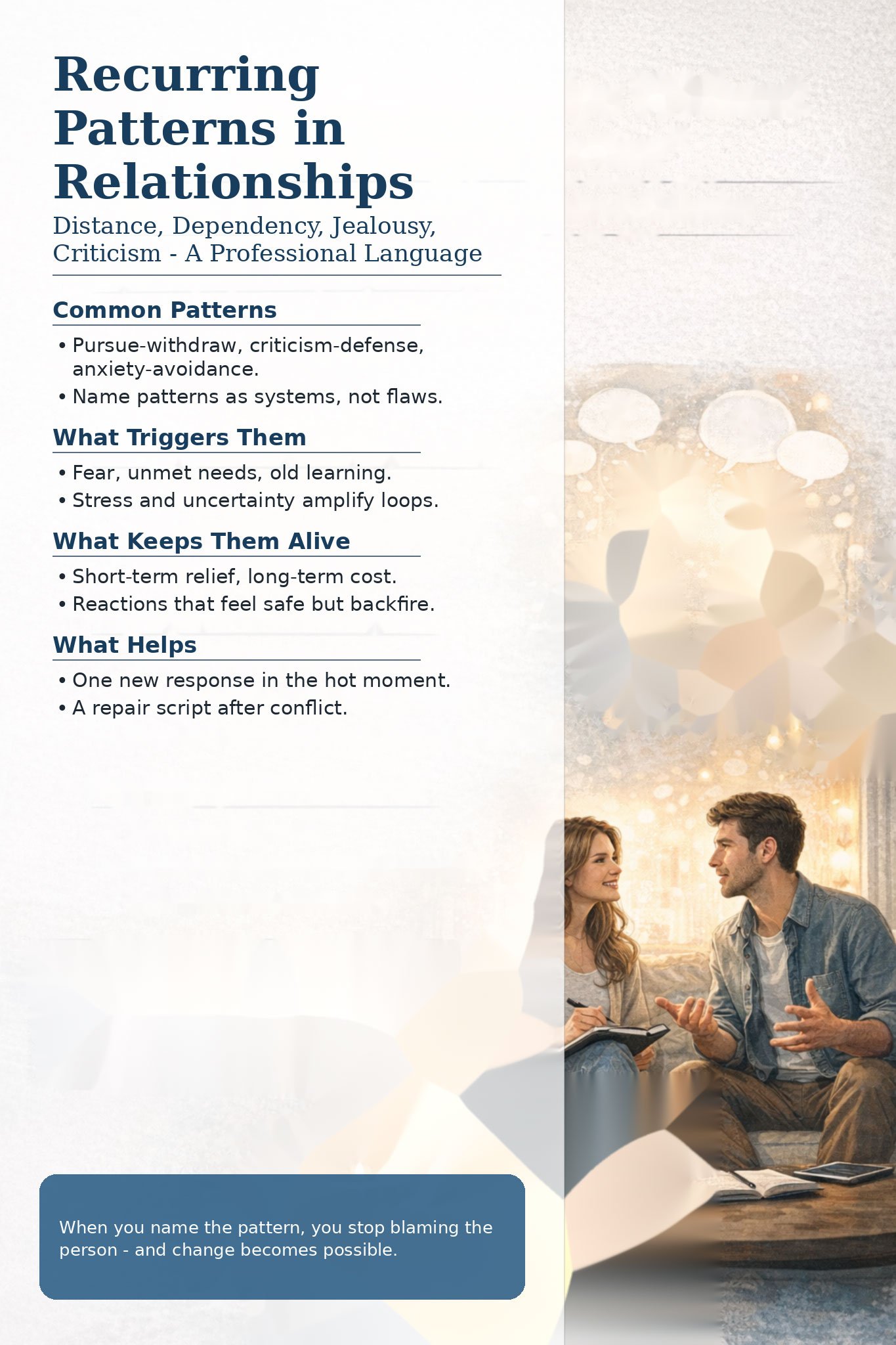
Recurring Relationship Patterns: Distance, Dependency, Jealousy, Criticism - A Professional Language

Recurring Relationship Patterns: Distance, Dependency, Jealousy, Criticism - A Professional Language

Repeating patterns are why fights look different but feel the same. This article gives you a professional language for relationship readings: how to identify withdrawal, dependency, jealousy, and criticism without labels or blame, how to map a loop in 5 minutes, and how to end every session with a weekly action and a measurable metric that creates real change.

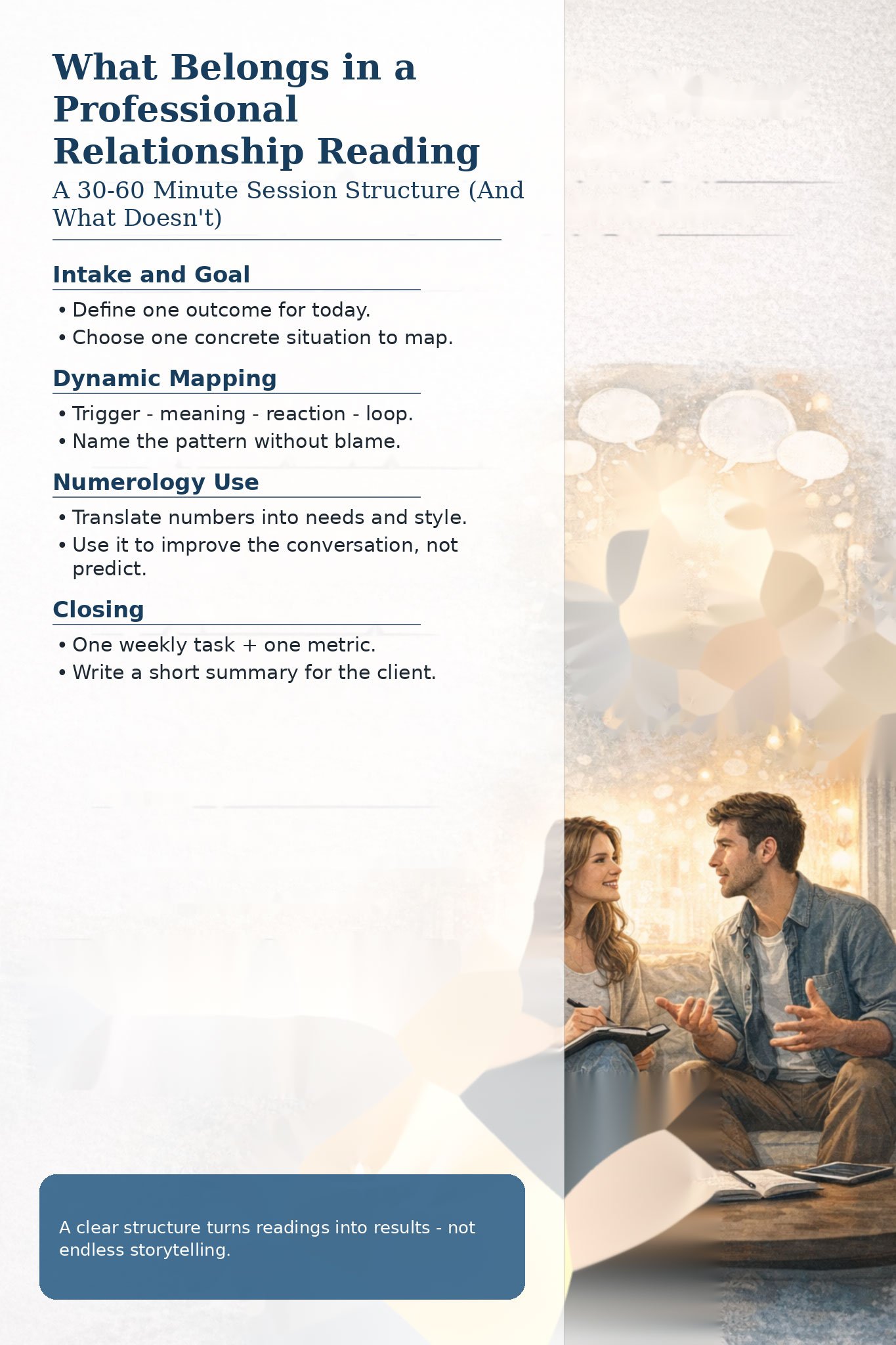
What Belongs in a Professional Relationship Reading - and What Doesn't

What Belongs in a Professional Relationship Reading - and What Doesn't

A professional relationship reading can be deep without being long. This article gives you a clear 30 or 60-minute structure: what belongs in the session, what doesn’t, how to work with repeating dynamics, how to use numerology responsibly, and how to end every reading with a weekly action and a measurable result.

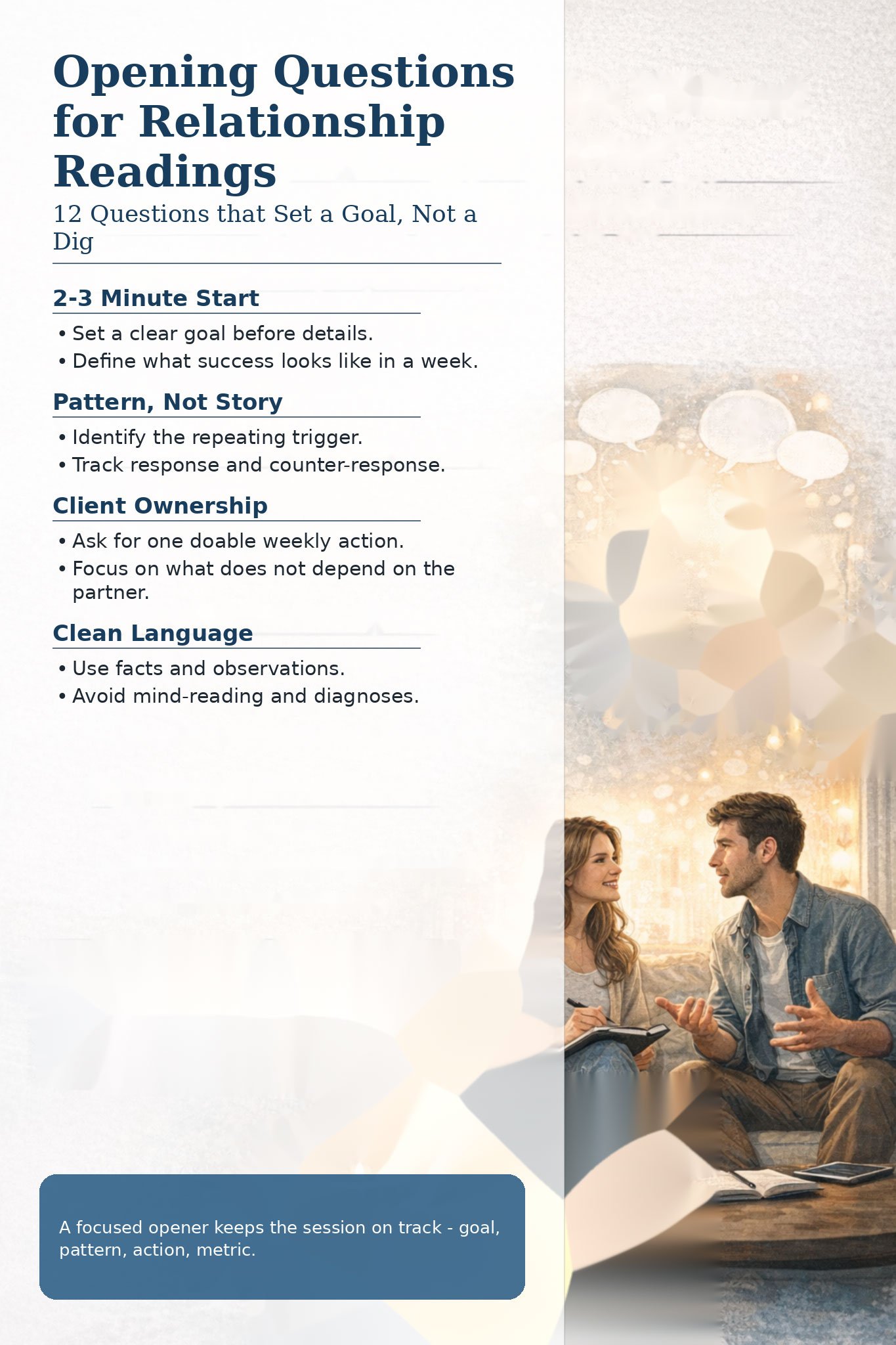
Opening Questions for Relationship Readings: 12 Questions that Set a Goal, Not a Dig

Opening Questions for Relationship Readings: 12 Questions that Set a Goal, Not a Dig

In professional relationship readings, the first question is half the diagnosis. This article gives you a 2-3 minute opening framework and 12 focused questions that set a clear goal, map the pattern, and create measurable action for the coming week - without getting lost in endless details and without turning the reading into investigation.

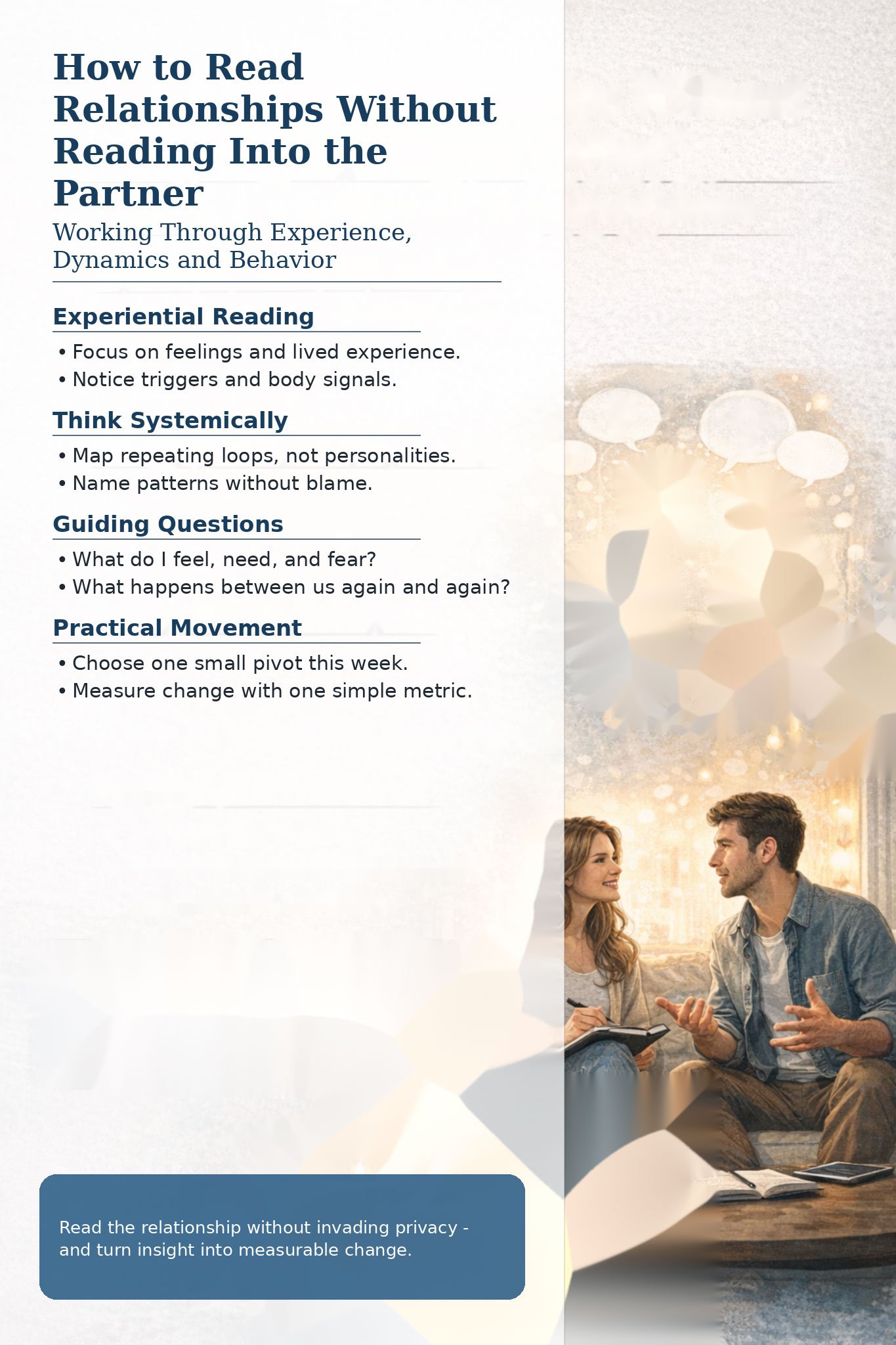
How to Read Relationships Without Reading "Into the Partner"

How to Read Relationships Without Reading "Into the Partner"

A professional relationship reading does not need, and should not, invade the partner’s privacy. This article teaches you how to read the relationship through the client’s experience, the repeating dynamics, and real behavior, with questions, language templates, and mini case studies that turn insight into measurable action - without guessing and without drama.

What Is Ethical in a Relationship Reading - and What Is Not

What Is Ethical in a Relationship Reading - and What Is Not

This article explains how to do relationship readings responsibly: what is ethical and what is not, how to avoid “reading the partner”, how to set boundaries without losing trust, and how to turn the session into practical tools for communication, boundaries, and a weekly action step. Includes ready-to-use scripts and red flags that require referral.

What Belongs in a Professional Reading - and What Does Not

What Belongs in a Professional Reading - and What Does Not

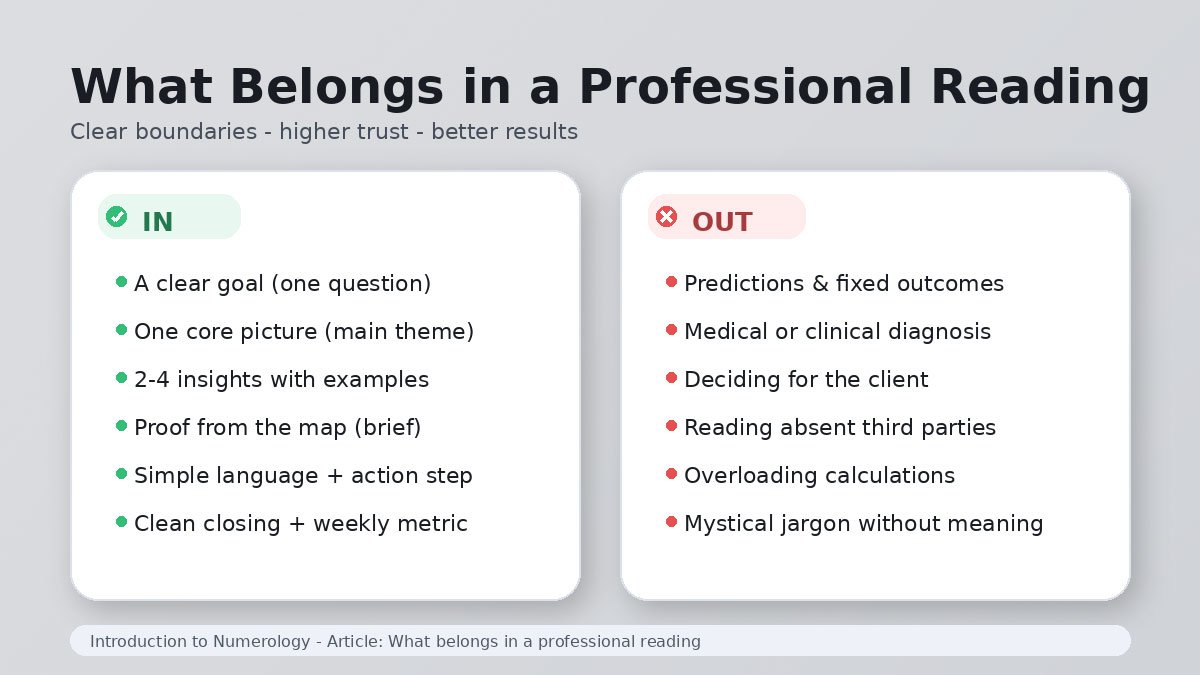
A professional reading is a focused process, not a list of calculations. This article explains what must be included (goal, core picture, 2-4 supported insights, clear closing and action) and what should never be included (predictions, diagnosis, overload, and deciding for the client). You also get practical filter questions, a clean session structure, and boundary scripts you can use with clients.

How to Use Simple Language Without Losing Depth

How to Use Simple Language Without Losing Depth

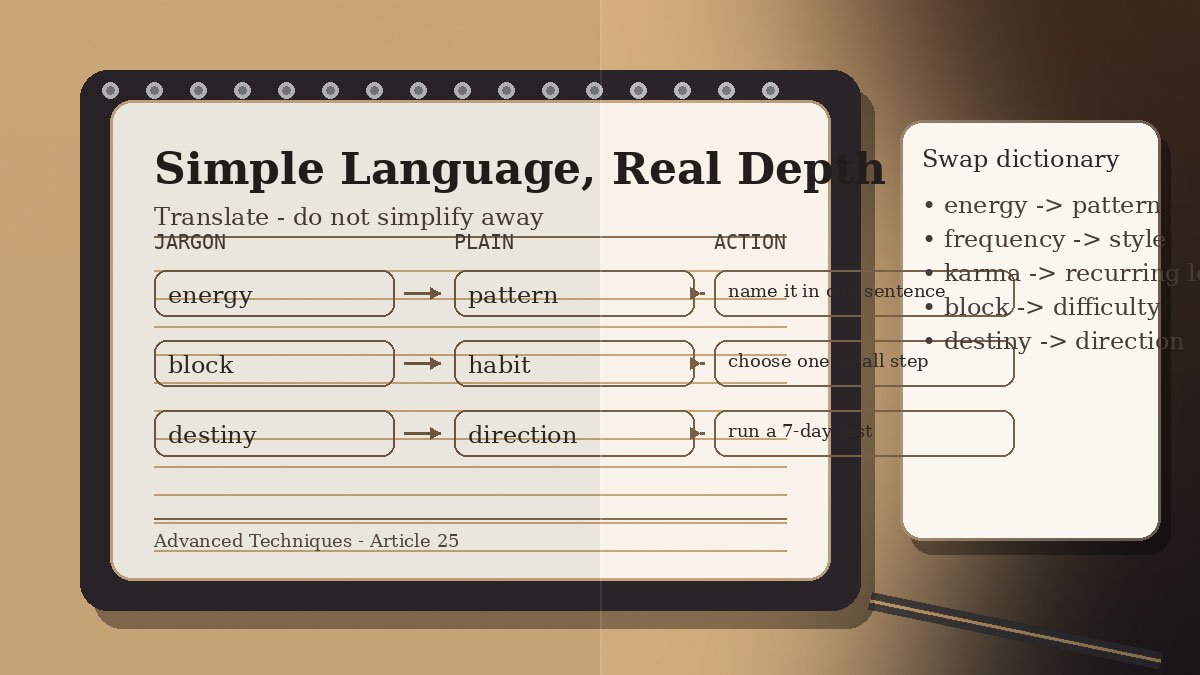
This article teaches how to communicate numerology insights in clear, simple language without losing depth. You get translation formulas from numbers to behavior and action, a swap dictionary from mystical jargon to human wording, before-and-after examples, and real-time questions that ensure the client truly understands and leaves with a practical step.

How to Find One Root Point That Explains Three Different Problems

How to Find One Root Point That Explains Three Different Problems

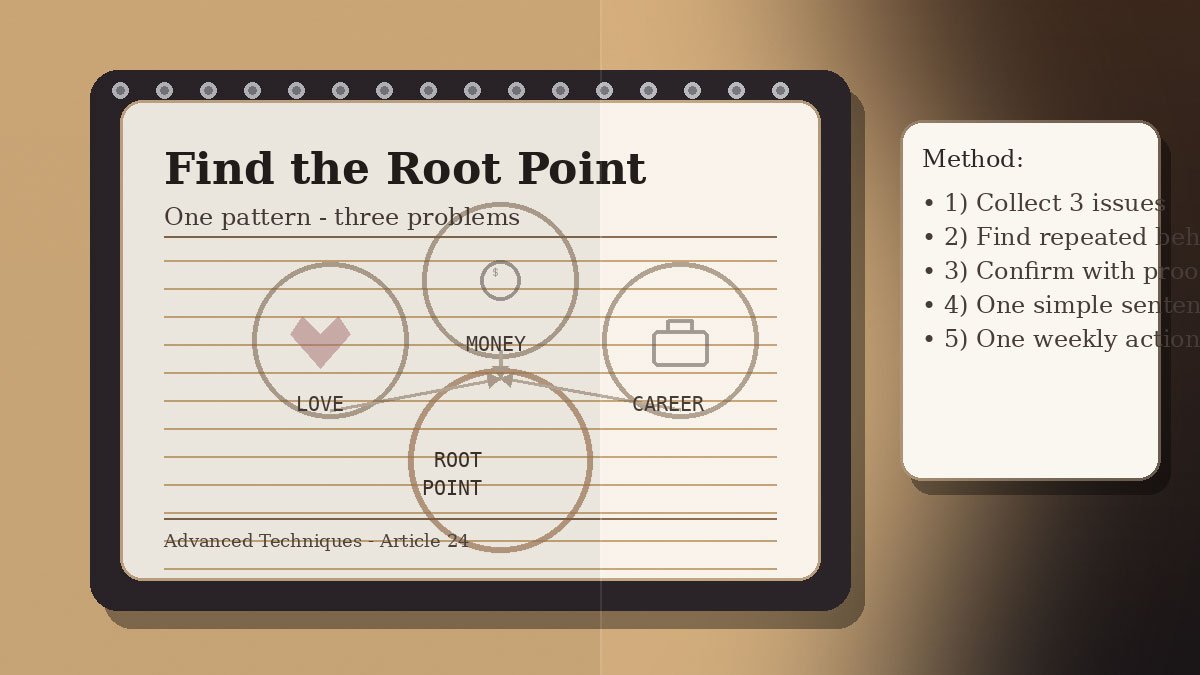
This article teaches how to identify one root pattern that explains multiple problems, making your readings deeper, clearer, and more actionable. You get a 5-step method, diagnostic questions, examples, and a way to turn the root into one measurable weekly action that improves several areas at once.

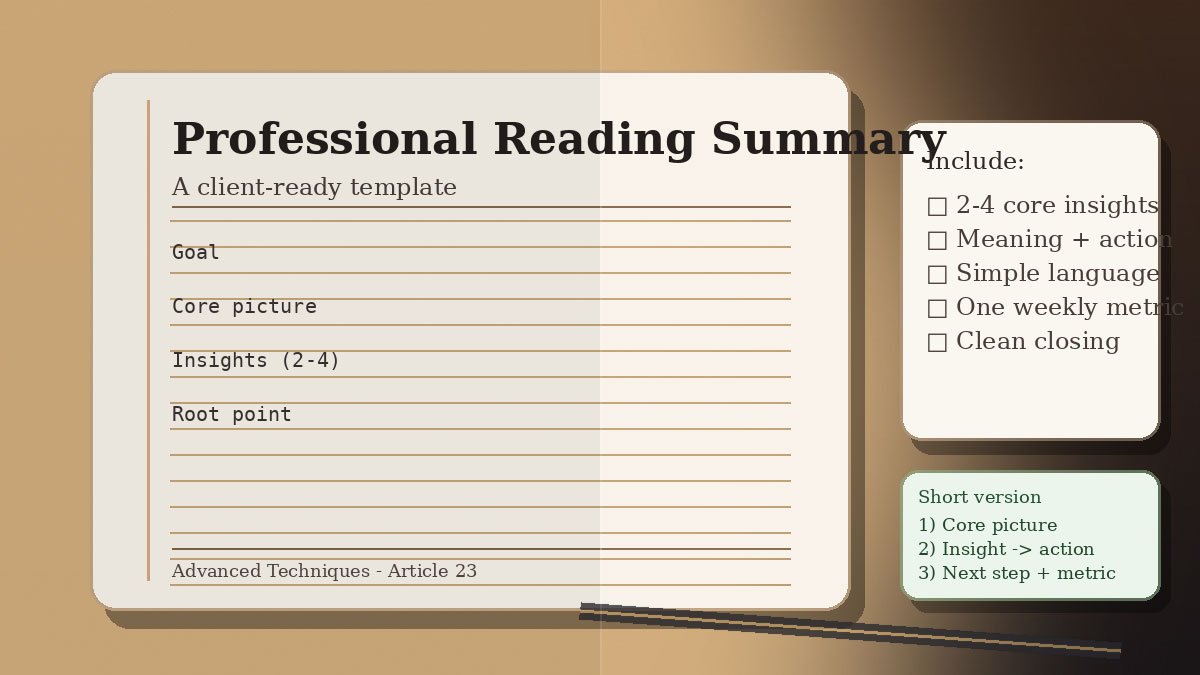
Professional Reading Summary: A Written Template You Can Send to Clients

Professional Reading Summary: A Written Template You Can Send to Clients

This article provides a copy-paste template for a professional post-session summary you can send to clients. It includes rules for writing sharp, non-generic summaries, a full structured template, a short WhatsApp version, and a complete example. The goal is to turn insights into action while reinforcing trust and professionalism.

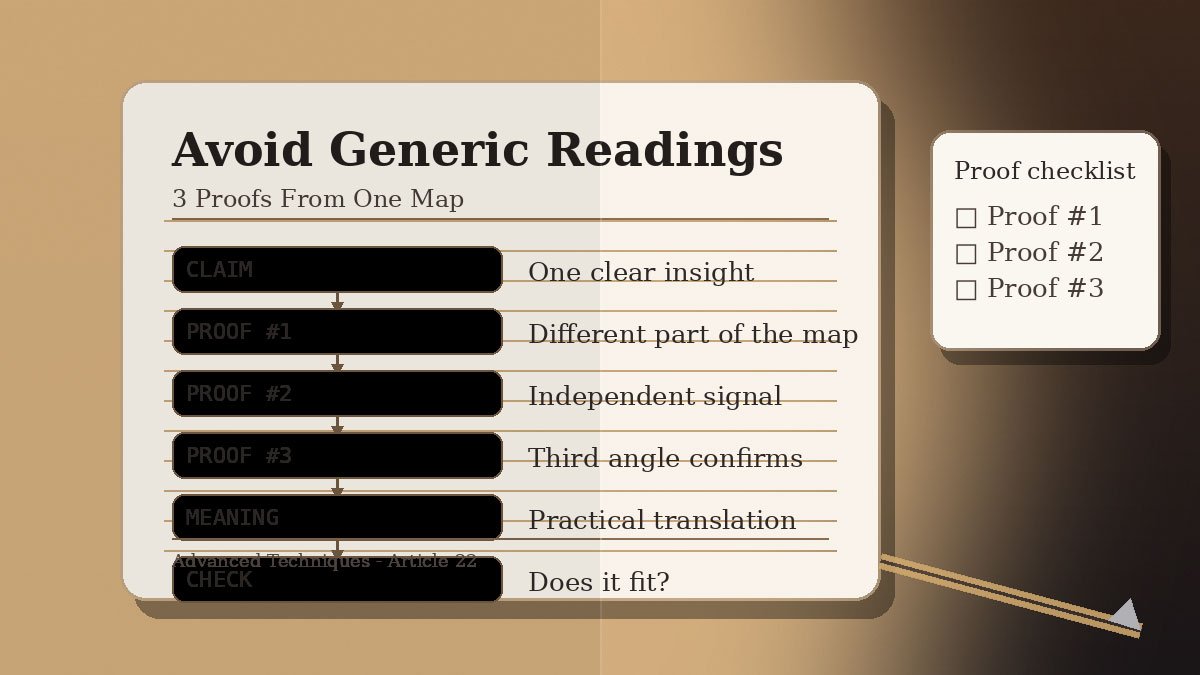
Avoid Generic Readings: The “3 Proofs From One Map” Technique

Avoid Generic Readings: The “3 Proofs From One Map” Technique

This article introduces a simple method that instantly raises professional level: before stating an insight, support it with three separate proofs from the same map. Learn how to form sharp, non-generic claims, present proofs in a trust-building way, and close with two to three strong conclusions and one practical step.

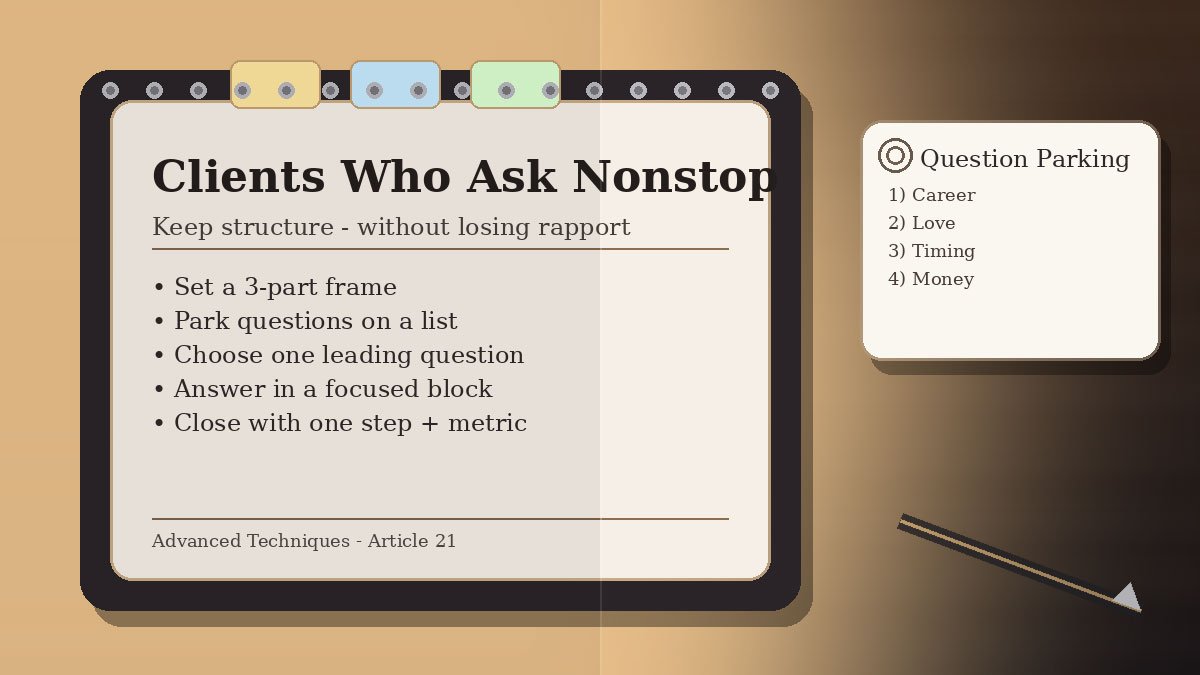
How to Work With a Client Who “Never Stops Asking” and Still Keep a Strong Session Frame

How to Work With a Client Who “Never Stops Asking” and Still Keep a Strong Session Frame

This article shows how to handle a client who floods the session with questions without losing rapport or letting the reading become scattered. You get an opening frame, the Question Parking method, gentle interruption scripts, a way to spot anxiety disguised as curiosity, and a closing template that ensures the client leaves with structure and one practical step.

How to Shift From a General Reading to a Focused Domain Reading (Love or Career) Without Changing Your Method

How to Shift From a General Reading to a Focused Domain Reading (Love or Career) Without Changing Your Method

A domain-focused reading is not a separate system - it is the same core pattern viewed through a domain lens. This article teaches a professional workflow to shift from general insight to love or career guidance using clear questions, domain triggers, balanced framing, practical calibration, and one measurable next step, with full examples and reusable templates.

Common Beginner Mistakes in Numerology - and How to Avoid Them

Common Beginner Mistakes in Numerology - and How to Avoid Them

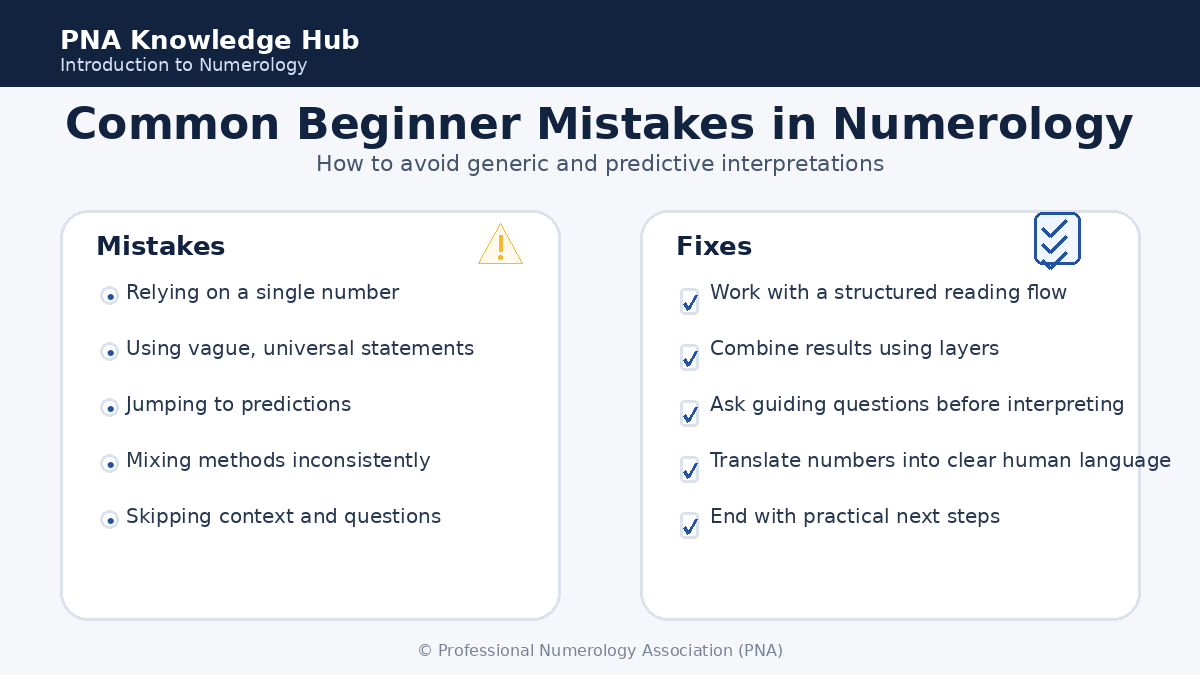
Beginners often make the same mistakes: vague statements, inconsistent methods, and jumping to predictions. This article shows how to spot those mistakes early, build a consistent process, and turn numbers into clear, practical readings.

Subscribe for Full Access

Learn and deepen your numerology knowledge with our professional articles

Subscribe for Full Access

Accessibility

Text Size
Display
Reading
Spacing